
If you’re a creator with 5,000 to 10,000 followers, you’ve probably heard the same advice over and over: just post more. But that treadmill of content creation often leads to one place—burnout, not a predictable income.
The real key to monetizing your audience isn't about getting bigger. It's about going deeper with the community you already have. It all starts with finding your true niche and building a digital product they can't wait to buy.
Why Chasing Followers Is a Flawed Monetization Strategy
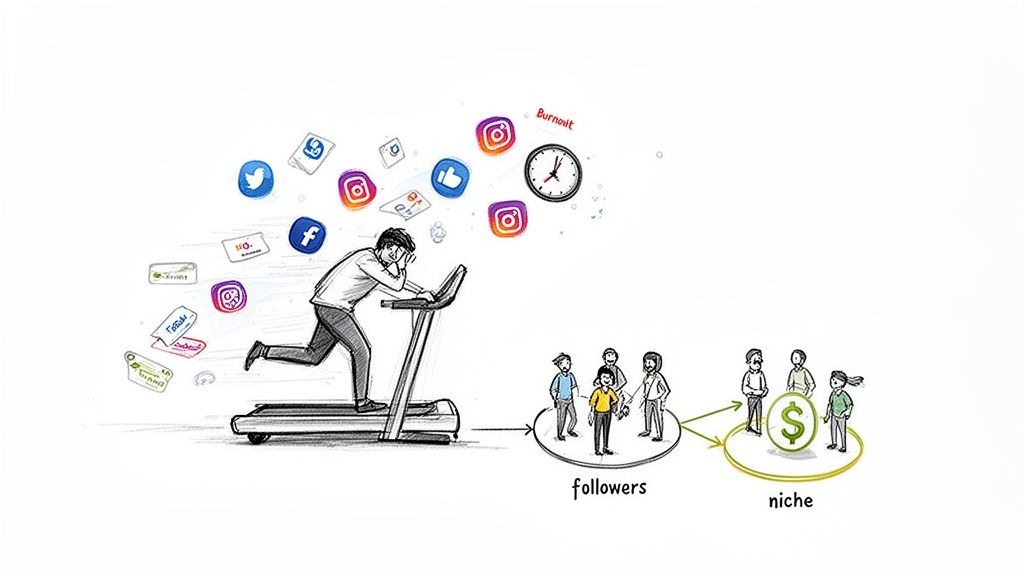
There's a persistent myth in the creator economy that more followers automatically translates to more money. But if you have a mid-sized audience, you know the reality is much more complicated.
You're likely stuck on a hamster wheel, chasing inconsistent brand deals and trading precious time for money with one-on-one coaching. This path doesn't just put a hard ceiling on your income; it's a direct route to exhaustion. You pour hours into creating content, engaging with your community, and managing DMs, only to watch your revenue swing wildly from one month to the next.
The problem isn't your talent or your work ethic. The real bottleneck is not knowing exactly what to sell to the audience that already knows, likes, and trusts you.
The Shift From Vanity Metrics to Value
The most successful creators I know have figured this out. They understand that the most sustainable way to build a business isn't about growing bigger, but about going deeper. It’s about making a conscious pivot from chasing vanity metrics—like follower counts—to serving a specific, dedicated niche with a targeted solution.
This single shift changes your entire business model from reactive to proactive. Instead of waiting around for a brand to notice you, you build your own revenue stream by solving a real problem for a specific group of people in your audience. This is where you finally unlock stable, predictable income.
The most valuable asset you have isn't your follower count; it's the trust you've built with your community. Monetizing that trust requires moving beyond broad content and offering a solution so specific it feels like a perfect fit for a select few.
Let’s make this real. Imagine you're a fitness creator with 7,000 engaged followers on Instagram. You post daily about handstand progressions and home workouts. You're tired of chasing brand deals that pay peanuts and you're capped out on one-on-one coaching at $2,000 a month.
Finding your niche market isn't about guesswork. It’s about data-driven discovery. A tool like Rupa's 60-Second Scan can analyze your posts, comments, engagement spikes, and audience behavior to uncover what your followers are desperately searching for. It replaces your intuition with actual evidence. For more great insights, you can explore Shopify's guide on niche markets.
By digging into what drives the most interaction, you can see exactly what people value. You can also monitor key performance indicators using tools like our Instagram engagement calculator to see which content truly hits home. This guide will give you a clear roadmap to do just that, so you can build a profitable business around the audience you already have.
Look for Niche Ideas Within Your Own Content
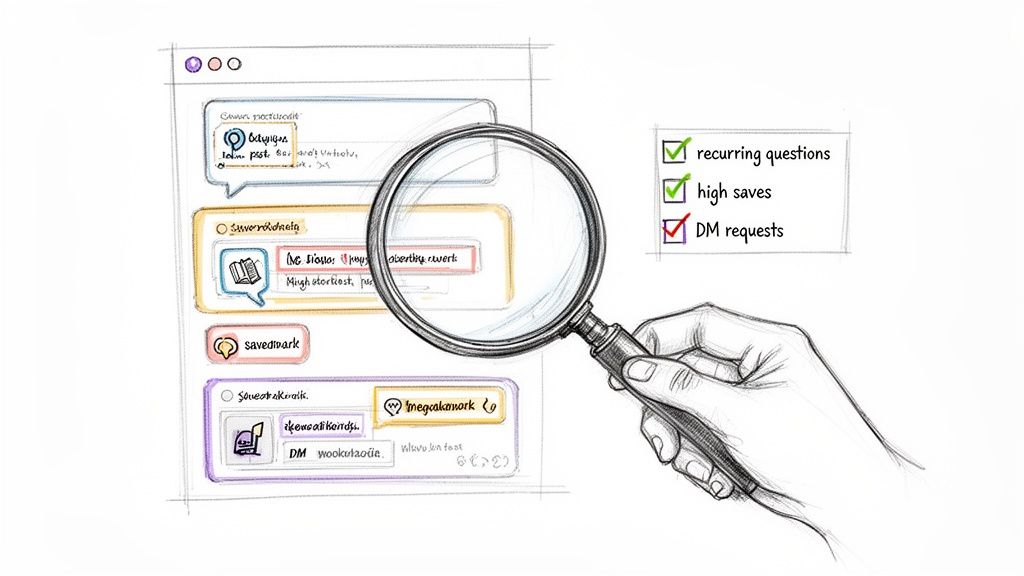
Believe it or not, your next killer product idea is probably hiding in plain sight. It’s sitting right there in your comments, DMs, and post analytics. Before you start wildly guessing what to create and sell, you need to do a little digging to see what your followers are already begging for.
This isn’t about becoming a data scientist overnight. It’s simply about paying close attention to the clues your community leaves for you every single day. These little signals are a goldmine, showing you exactly where the real demand is. You just need to know what to look for.
The Content Goldmine Checklist: 4 Clues to Spot
Set aside an hour and go through your last 90 days of content. The mission here is to spot the patterns. For a moment, forget what you think your audience wants and focus entirely on what their actions are telling you.
Here are the signals that practically scream "unmet need":
Recurring Questions: Are you getting the same exact question over and over again in your comments or DMs?
- Example: A productivity coach constantly gets asked, "Can you share your Notion template for project planning?" This isn't a coincidence—it's a direct signal of demand for that exact tool.
High Save Counts: Saves are one of the most powerful indicators of value. A post that gets saved is content your audience wants to return to.
- Example: A food blogger might notice that every post about '30-minute vegan meals' gets 3x more saves than any other recipe. That’s a clear market signal for quick, plant-based meal solutions.
"How-To" Inquiries: Keep an eye out for comments like, "How did you do that?" or "Can you walk us through the steps for X?"
- Example: A DIY crafter posts a time-lapse of creating a macrame wall hanging and gets flooded with comments asking for a step-by-step tutorial. These are literal requests for structured knowledge, the foundation of a great digital product.
Follower Language: Pay attention to the exact words and phrases your audience uses to describe their problems.
- Example: A home organization influencer sees followers constantly mentioning they feel "overwhelmed by kid clutter" or "drowning in toys." That's the language you should be using in your product description to show you truly understand them.
Think of yourself as a detective. Every comment, save, and DM is a clue. When you piece them together, they don’t just hint at a niche; they give you the exact blueprint for a product your audience is already asking to buy.
From Clues to Actionable Ideas
Once you've collected these clues, it’s time to get organized. A simple spreadsheet or a note in your phone is perfect for tracking the patterns you find. This simple step helps you move from just a gut feeling to having hard evidence.
Let’s imagine a fitness creator does this and finds:
- 15 DMs in the last month asking for her "post-workout stretch routine."
- Her two Reels demonstrating mobility exercises have the highest share counts of all her videos.
- Comments frequently mention problems like "tight hips" and "lower back pain."
Suddenly, the niche isn't just "fitness" anymore. It's "mobility solutions for people who get stiff after working out." That level of specificity is what makes an offer feel like it was created just for them.
Of course, getting these signals depends on creating great content in the first place. This is where tools like an Instagram caption generator can help you craft messages that resonate and pull these valuable insights out of your audience.
The same principles apply no matter the business model. You can even learn how to find a dropshipping niche by applying this same detective work to broader market trends. The core idea is always the same: listen to the demand that’s already out there.
Why a Smaller Audience Can Mean Bigger Profits
It feels backward, doesn't it? The idea that targeting a smaller group of people could actually make you more money. But I’ve seen it time and time again with creators I’ve worked with: shrinking your focus is one of the most powerful things you can do to blow past your revenue goals.
Going niche isn't just some marketing trick. It’s a complete shift in how you build your business online.
When you try to be everything to everyone, you inevitably become nothing special to anyone. Picture the generic "wellness influencer." One day they're posting HIIT workouts, the next it's green smoothies, and then a meditation reel. Their content is all over the place, their competition is practically everyone with a yoga mat, and their audience’s loyalty is paper-thin.
Now, think about a "breathwork coach for new moms." This creator solves a very specific problem for a very specific person. Almost overnight, they become the go-to expert in their little corner of the internet.
3 Ways Niching Down Boosts Your Income
Niching down does three crucial things that immediately boost your ability to make a profit. It cuts down your competition, helps you build a fiercely loyal community, and gives you the authority to charge premium prices for what you know. When you're the only one offering the perfect solution, you don't have to compete on price anymore.
Here's how a focused niche makes your marketing and sales feel almost effortless:
- Your content becomes hyper-relevant. Every single post, story, and video speaks directly to your ideal customer's biggest frustrations and deepest desires. Your engagement skyrockets because your content finally feels like it's for them.
- Your products feel custom-made. Instead of a generic guide, you're offering a targeted solution. This makes the decision to buy a no-brainer and naturally leads to higher conversion rates.
- Your community becomes your biggest asset. A small, dedicated audience that feels truly seen and understood is infinitely more valuable than a massive, disengaged one. They become your best advocates.
A niche doesn't limit your audience; it filters it. You're not reaching fewer people, you're reaching the right people—the ones who are most likely to become paying customers because you solve their exact problem.
This table really drives home the difference between the two approaches.
Mass Market vs Niche Market for Creators
| Factor | Mass Market Approach | Niche Market Approach |
|---|---|---|
| Competition | Extremely high; a "red ocean" of creators | Minimal; you can become a big fish in a small pond |
| Audience | Broad, disengaged, and shallow | Small, highly engaged, and deeply connected |
| Pricing Power | Forced to compete on price; race to the bottom | Can command premium prices for specialized expertise |
| Marketing | Expensive and inefficient; shouting into the void | Highly targeted, cost-effective, and word-of-mouth driven |
| Loyalty | Low; followers are easily swayed by the next trend | Extremely high; builds a true, supportive community |
By focusing on a niche, you're not just making content; you're building a sustainable and profitable business on your own terms.
The Financial Upside of a Focused Niche
When you target a niche market, you slash competition and skyrocket loyalty. This is a total game-changer, especially for creators with smaller followings. Unlike mass markets flooded with look-alike offers, niches allow you to charge premium prices. Think about specialized vegan goods, where customers will happily pay 20-50% more for a product that perfectly meets their needs.
This strategy works because there's less competition, and you can use precise marketing that really connects with your audience. In fact, focused marketing can boost engagement by up to 27% simply because you understand your customer so deeply. You can read more about how niche markets drive profit and engagement on Social Champ's blog.
Let's look at a real-world example. Imagine a nutrition coach with 8,000 followers. Instead of selling another generic "healthy eating" guide, she creates a $37 PDF on "30 High-Protein Meals for Busy Vegan Professionals."
This offer is so incredibly specific that it resonates deeply with a small segment of her audience. Even with a conservative 2% conversion rate from her followers, that’s a $5,900 launch from a single, simple product.
This level of focus also makes creating content so much easier. You'll never run out of ideas, and writing compelling hooks becomes second nature. If you ever get stuck, a good TikTok caption generator can help you brainstorm different angles that speak directly to what your niche audience cares about.
At the end of the day, a small, dedicated audience isn't a limitation—it's your most valuable asset for building a sustainable business.
How to Validate Your Product Idea Before You Build It
Having a brilliant idea for a digital product is one thing. Knowing for a fact that people will actually buy it? That’s something else entirely.
Before you sink weeks or even months into creating something nobody wants, you need to validate your idea with real feedback from your target audience. The good news is, you don't need a huge budget or fancy software. You can test your concept with the tools you already use every day: your social media accounts.
Let's walk through a low-effort playbook to get clear signals of demand, so you can build your next product with confidence.

Use Your Social Media to Test the Waters
Your followers are your built-in focus group. The trick is to ask for their input in a way that feels natural and collaborative, not like a sales pitch. You're not announcing a finished product; you're inviting them into the creation process.
This entire approach works best when you've already niched down. When you serve a specific audience, it's easier to understand their problems and create a solution they'll eagerly pay for.

As you can see, a focused niche leads to less competition, which helps you build a loyal community and gives you the authority to charge premium prices.
Here are three practical ways to validate your product ideas using social media:
- Run Strategic Instagram Polls: Use the poll or quiz sticker in your Stories to gauge interest. Don't just ask, "Would you buy this?" Get more specific. A fitness creator could ask, "Which would be more helpful for your goals? A) 7-Day Handstand Guide or B) 30-Day Mobility Plan." This gives you direct, comparative data on what your audience actually wants right now.
- Host a Targeted Q&A Session: Announce a Live or a Story Q&A focused on the exact topic of your potential product. If you're thinking of creating a guide on "budgeting for freelancers," host a session on that subject. The number and depth of questions you get is a direct measure of how big that pain point is for your audience.
- Create a "Feeler" Post: Draft a simple in-feed post that tests the core concept. You’re not selling anything yet. You’re just starting a conversation to see who bites. For example, a post titled "My Top 3 Tips for [Your Product Topic]" can gauge interest based on the engagement it receives. This "soft-launch" approach helps you gather valuable feedback.
Copy-and-Paste Scripts to Measure Interest
Knowing what to say is half the battle. You want to sound direct without being pushy. Here are a few scripts you can tweak and use on your feed, in Stories, or even in DMs with your most engaged followers.
For an In-Feed Post or Story:
"Been kicking around an idea for a 7-day guide to [your topic, e.g., 'meal prepping for weight loss']. If you've ever struggled with this, what’s the #1 thing you find most challenging?"
For a DM to a Warm Follower:
"Hey [Name]! I saw you liked my recent post on [topic]. I’m exploring the idea of a mini-workshop on this. Is that something you'd find valuable?"
For Creating a Simple Waitlist:
"Thinking of launching a [product type] to help you [achieve specific result]. I'm only opening it up to a small group first. Drop a '🔥' below if you want to be the first to know when it's ready."
Before you commit your time and energy, you also need to understand the market landscape. Learning how to conduct thorough competitor analysis can show you what's already out there and help you spot gaps your product can fill.
Ultimately, every comment, poll vote, and DM is a piece of data telling you whether you're on the right track. This validation is how you find a profitable niche and make sure you're building something people are truly excited to pay for.
Turning Your Niche Idea into a Profitable Digital Product
Alright, you’ve done the hard work and validated your niche idea. Now for the exciting part: turning that concept into something your audience can actually buy. This is the moment you bridge the gap between having an engaged audience and building a real, sustainable income stream.
The secret here is to match your product's format to your expertise and, most importantly, the specific problem your audience is trying to solve. Don't fall into the trap of thinking you need to build some massive, all-encompassing course. More often than not, the simplest and most focused products sell the best because they promise a quick, clear win.
5 Proven Digital Product Formats That Sell
The beauty of digital products is just how flexible they are. You can package your knowledge in so many different ways. Here are five of the most effective formats for creators with a dedicated niche audience:
Paid Challenges: These are absolute gold for action-oriented niches. They create urgency and community, making them a great first product.
- Example: A fitness creator launches a “7-Day Handstand Challenge” or a finance coach starts a “14-Day No-Spend Challenge.”
Guides and eBooks: If your audience is hungry for detailed information they can reference again and again, a well-designed PDF is a fantastic choice.
- Example: A nutrition coach creates a “30 High-Protein Vegan Recipes” eBook, or a crochet creator sells a “Retro Bucket Hat Pattern” PDF.
Workshops and Webinars: Perfect for teaching a specific, high-value skill in a live or pre-recorded session.
- Example: A productivity expert hosts a 90-minute workshop on "Mastering Asana for Small Teams," complete with a live Q&A.
Templates and Planners: Some audiences need tools, not just information. Templates are instant time-savers that provide immediate value.
- Example: A business coach sells a "Client Proposal Template," or a graphic designer offers a "Canva Social Media Template Pack."
Audio Packs: In niches like mindfulness, personal development, or language learning, audio files are incredibly powerful.
- Example: A breathwork mentor sells a “Daily Calm Audio Pack” with a series of guided five-minute meditations.
Structuring Your Product for Maximum Value
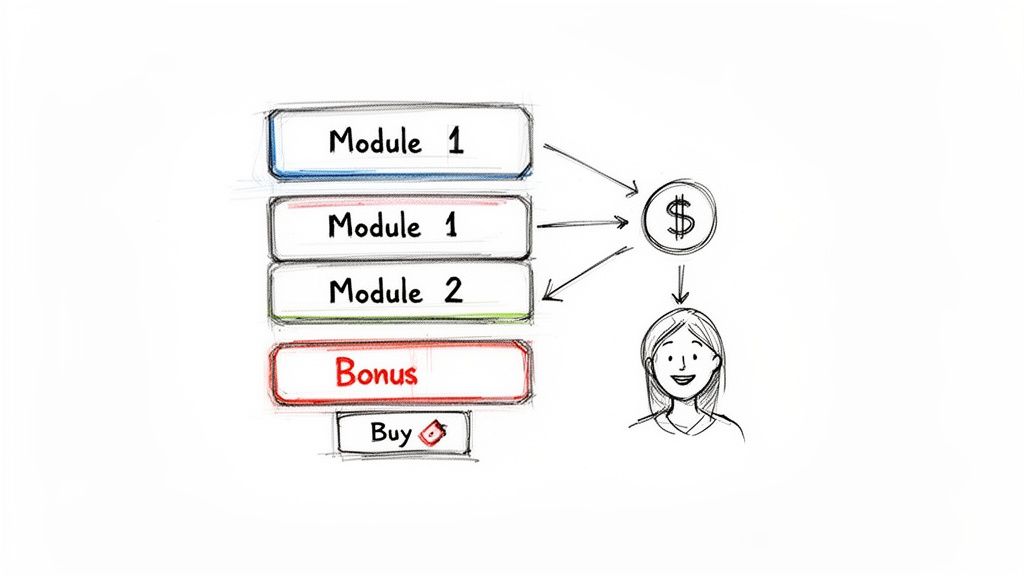
A great digital product is so much more than just a folder of content. It’s a structured journey designed to lead your customer from point A to a specific result at point B. Your offer needs clear modules or sections, with each one building on the last.
Let's take that “7-Day Handstand Challenge” as an example. It could be structured like this:
- Day 1: Wrist Prep and Core Foundations
- Day 2: Building Shoulder Strength
- Day 3: Finding Your Balance
- …and so on.
Want to make your offer truly irresistible? Add bonuses that tackle common objections or enhance the core product. This could be a bonus PDF on “Common Mistakes to Avoid” or a link to a private community for extra support and accountability.
A well-structured product with valuable bonuses doesn't just increase the price you can charge—it significantly improves the chances that your customer will actually achieve the result you promised.
Simple Pricing Strategies That Work
Pricing your first digital product can feel like a guessing game, but it doesn't have to be so complicated. The real goal is to choose a price that reflects the value of the transformation you're providing.
A simple yet effective strategy is to find that sweet spot between being accessible and signaling real value. For creators with 5-10k followers, I’ve seen price points like $27, $37, or $47 work incredibly well for a first product. These prices are low enough for an impulse buy from a warm audience but high enough to show you're offering something substantial.
The magic of a niche market is finding those underserved corners where demand is high but supply is low. Globally, niches like remote workers or conscious consumers are booming. But the real advantage is that less competition means you can become the go-to expert much faster. In fact, niche firms report that their customers are 2-3x more likely to make repeat purchases.
There are even tools like Rupa that can scan your followers and help you brainstorm offers like a “14-Day No-Spend Challenge” for a finance-focused audience, complete with a suggested structure and price. You can learn more about the power of niche markets on Clientify to see just how much potential is out there.
Got Niche Questions? Let's Clear Things Up
Even when you think you've found the one, a few doubts can start to bubble up and stop you in your tracks. Trust me, that's completely normal. Getting over that hurdle means tackling those nagging questions with a solid plan so you can move forward with confidence.
Let's walk through some of the most common worries I hear from creators.
"Is My Niche Too Small to Actually Make Money?"
If you have an audience of 5,000-10,000 followers, a "small" niche is actually your secret weapon. Profit isn't about having a giant audience; it's about having high conversion rates within a dedicated community. I'd take a hyper-engaged group of 1,000 true fans over 100,000 casual scrollers any day of the week.
When you solve a very specific and urgent problem for a small group, they're not just interested—they're ready to buy.
A small, passionate audience sees you as the go-to expert. That's how you build the trust needed to make sales. You're not just another random voice in a crowded space; you're their person.
Think about the math. Converting just 2% of a 7,000-follower audience with a $47 digital product brings in over $6,500. The real magic is in going deep with your audience, not wide.
"How Many Digital Products Do I Need to Create?"
One. Start with one.
I see so many creators fall into the trap of trying to build an entire library of products right away. That's a recipe for burnout. All your energy should go into creating and launching a single, high-value "core" product that solves the #1 problem your niche is facing.
What could that first product look like? A simple list:
- A paid challenge: These are fantastic for building momentum and creating a sense of community around a common goal.
- A comprehensive guide: Perfect for a topic that needs a detailed, step-by-step roadmap.
- A focused workshop: An excellent choice for teaching a specific, in-demand skill your audience keeps asking about.
After you nail that first launch and get real feedback from paying customers, then you can think about what comes next. Future products can build on your first one, creating a natural progression that lets your biggest fans buy from you again and again.
"My Audience Likes a Few Different Topics. Do I Have to Pick Just One?"
For your first product? Absolutely, yes. It’s fantastic that you have a multi-passionate audience, but a product that tries to please everyone will end up helping no one. The sweet spot is finding that powerful intersection of what you love, what you're an expert in, and what a specific slice of your audience is desperate to solve.
Not sure where to start? Go look at your analytics. Find the topic that consistently gets more:
- Saves and shares
- Thoughtful, in-depth comments
- Detailed questions in your DMs
That's your cue. That’s where the energy is. You can always explore your other interests later on, but launching with a single, focused product is the fastest way to generate real, predictable income. Serve your most engaged followers first. If you're looking to really nail down your monetization strategy, the resources at Rupa are a great place to start turning your passion into a business.
Ready to stop guessing and start selling? Rupa is an AI-powered platform that analyzes your audience to tell you exactly what digital product to launch. Get niche-matched product ideas, sales page copy, and all the assets you need to monetize your audience in hours, not weeks. Find out what your audience wants to buy at https://rupa.pro/