
To build an email list, you've got to offer something valuable for free—a lead magnet—in exchange for an email address. Then you promote it across your social channels and use an email marketing platform to manage all your new subscribers. The core idea is simple: give your followers a compelling reason to move from a public feed to your private inbox.
Why an Email List Is Your Most Valuable Asset
As a creator, it’s easy to get obsessed with your follower count. It feels like the most important metric. But here's the hard truth: relying solely on platforms like Instagram or TikTok is like building a house on rented land. One algorithm change can decimate your reach overnight. Brand deals can dry up in an instant, leaving you with a totally unpredictable income.
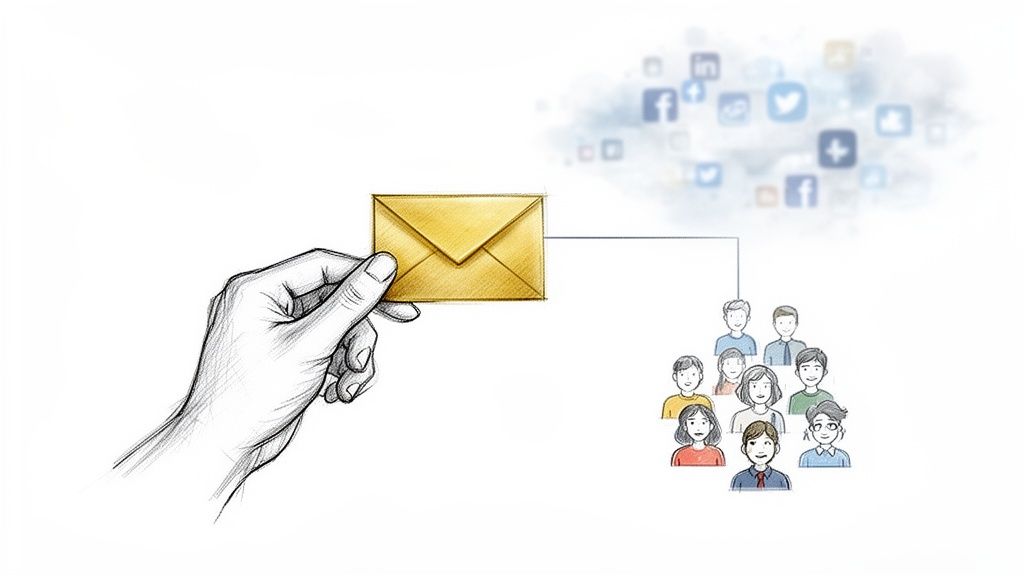
This is where an email list completely changes the game for your business. It's the only digital asset you truly own. It's a direct, unfiltered line to your most dedicated followers, and it's completely immune to the whims of social media algorithms.
Shifting From Rented Land to Owned Property
Let's break down the real difference between a social media follower and an email subscriber. A follower sees your content only when the platform's algorithm decides to show it to them. An email subscriber, on the other hand, has literally raised their hand and said, "Yes, I want to hear more from you." That's a huge distinction.
Your email list isn't just a collection of contacts; it's a community of your most engaged fans who are primed to support your next launch, read your latest update, or buy your new product.
This direct access translates into real, tangible growth. While social media is fantastic for discovery and top-of-funnel engagement, email is where the deep relationships are built and where revenue is actually driven. The numbers don't lie—for every $1 spent on email marketing, businesses can expect an average return of $49. It's a powerhouse.
4 Game-Changing Benefits of an Email List for Influencers
Owning your audience means you control the conversation and the timing. You’re no longer just shouting into the void and hoping your content breaks through the noise.
Here are 4 practical ways an email list helps you build a real business:
- Direct Communication: When you hit "send" on an email, it lands right in your subscriber's inbox. No algorithm is hiding it or prioritizing someone else's content.
- Higher Engagement: Think about it—the people who take the extra step to subscribe are already your biggest fans. This naturally leads to much higher open rates and click-throughs compared to the fleeting attention you get on a social media feed. If you're curious how your audience stacks up on socials, a tool like this Instagram engagement calculator can give you a baseline.
- Monetization Control: Your list is the perfect launchpad for digital products, affiliate promotions, or exclusive paid content. You're selling to a warm audience that already knows, likes, and trusts you, which creates a stable income stream that isn't dependent on brand deals.
- Building a Sustainable Career: At the end of the day, an email list is what turns your creative passion into a scalable, long-term business. It’s the foundation for real growth and financial stability.
For those who want to go deep on mastering these kinds of growth strategies, pursuing a diploma in digital marketing can provide a powerful, comprehensive education. It helps you see how owning your audience fits into the bigger picture of a successful online business. Now, let’s get into the practical steps you can take to get started.
Choosing Your Email Marketing Platform
Alright, you're sold on why an email list is a game-changer. Now for the fun part: picking the tool to actually build and manage it. This is where a lot of creators get stuck, imagining some complex, techy nightmare. I promise it’s not that bad.
Think of your email platform as your home base—the one place where you can connect with your audience, send out updates, and eventually, sell your stuff without an algorithm getting in the way.
As a creator, you don't need the same heavy-duty system a Fortune 500 company uses. You need something that’s easy to learn, smart enough to handle the basics automatically, and won't cost a fortune while you're still growing. The focus should always be on what actually matters for you: a clean interface, simple automations, and a price that makes sense.
What to Look for: A 3-Point Checklist for Influencers
Before we get into specific brand names, let's talk features. It's easy to get distracted by a laundry list of bells and whistles you'll likely never touch. Don't fall into that trap.
Instead, zero in on these three things:
- Simple Automations: This is non-negotiable. Can you set up a welcome email that automatically fires off your free guide the second someone signs up? If not, walk away. Good automation is what keeps you from manually sending every single email.
- Intuitive Interface: You're a creator, not a coder. The platform needs to feel good to use. A drag-and-drop email builder is a must-have, letting you design beautiful emails without ever looking at a line of code.
- Scalable Pricing: Look for a platform with a generous free plan or a low starting price. The best tools for creators grow with you, meaning the cost is tied to how many subscribers you have. You shouldn't have to pay enterprise-level prices when you're just starting out.
The goal isn't to find the platform with the most features; it's to find the one that feels the least intimidating and lets you get started today. You can always switch later, but momentum is everything.
Top Email Platforms for Social Media Creators
While there are dozens of options out there, the creator community tends to gravitate toward a few key players. ConvertKit, Flodesk, and Mailchimp are the big three, and for good reason. Each one shines in a different area, so the "best" one really depends on what you value most.
ConvertKit is pretty much built from the ground up for creators. If you plan on selling digital products, courses, or presets, it’s probably your best bet. Its automations are incredibly powerful but are laid out visually, so you can actually see the journey your subscribers are taking.
Flodesk is all about aesthetics. If your brand is highly visual and you want your emails to look like they were designed by a pro, this is your platform. Their templates are hands-down the most beautiful out of the box. Plus, they have a flat-rate pricing model, which is a huge perk once your list starts to grow.
Mailchimp is the OG of email marketing and a fantastic starting point. Their free plan is solid, and the platform is known for being super user-friendly. It's a great all-rounder for anyone just dipping their toes into building an email list.
To help you decide, I've put together a quick comparison of the platforms based on what creators like us care about most.
Email Platform Comparison for Creators
This table breaks down the key differences to help you see which platform's DNA best matches your own.
| Platform | Best For | Key Features | Pricing Model |
|---|---|---|---|
| ConvertKit | Creators selling digital products and courses | Powerful automations, subscriber tagging and segmentation, simple landing page builder | Free plan up to 1,000 subscribers, then scales with list size |
| Flodesk | Visually-driven creators who want beautiful emails | Stunning, easy-to-use email templates, unlimited subscribers for a flat fee, simple interface | Flat-rate monthly or annual subscription |
| Mailchimp | Beginners looking for a reliable, all-in-one tool | Generous free plan, easy drag-and-drop editor, good for simple newsletters | Free plan up to 500 subscribers, then scales with list size and features |
At the end of the day, this choice is just one step in the process. My advice? Pick the one that resonates with your immediate needs and budget. You can start for free on ConvertKit or Mailchimp just to get a feel for things. The most important action you can take is to simply choose one and get going.
Creating Lead Magnets Your Followers Will Actually Want
Let’s be real. The fastest way to get people onto your email list isn't some secret "growth hack." It's having something genuinely useful to give away for free. We call this a lead magnet, and it’s the entire reason someone goes from a casual scroller to an engaged subscriber who actually wants to hear from you.
Think of it this way: your lead magnet is the handshake, the first impression. You want it to be so good that people think, "Wow, if this is what they give away for free, their paid stuff must be incredible." It needs to solve a real, nagging problem for your audience and give them a quick win.
Uncovering Your Audience's Pain Points
The best ideas for lead magnets aren't just pulled out of thin air. Your audience is literally telling you what they want every single day—you just have to listen.
Here are 3 practical ways to find your next lead magnet idea in 30 minutes:
- Snoop through your DMs: What are the top 3-5 questions you get asked over and over again? Example: If you’re a travel influencer and everyone asks “How do you pack light?”, your lead magnet could be a "Carry-On Only Packing Checklist."
- Scan your comment sections: Look for comments like, "How did you do that?" or "Can you explain this part more?" People are straight-up telling you what they need help with.
- Check your most-saved posts: The content your followers save is the stuff they find most valuable. If your most saved post is a Reel with 5 photo editing tips, your lead magnet should be a "Free Lightroom Preset."
Doing this little bit of recon work helps you get out of your own head. You stop guessing what they want and start creating what you know they need.
The Anatomy of an Irresistible Lead Magnet
A great lead magnet isn't about being fancy or long. It's about being effective. The best ones all share three key traits.
- It Solves a Specific Problem: "Get Healthy" is way too broad. But "My 5-Minute Morning Mobility Routine for Desk Workers"? Now that’s specific, and it targets a clear audience.
- It Delivers a Quick Win: Your follower should get a tangible result almost immediately. Checklists, templates, and short guides are perfect for this. They feel instantly rewarding.
- It's Instantly Accessible: The second they sign up, that freebie should be in their inbox. No waiting. A downloadable PDF, a link to an unlisted video, or a simple template works perfectly.
Your lead magnet is the first promise you make to a new subscriber. If you deliver something high-quality and genuinely helpful, you build trust from the very first click.
Niche-Specific Lead Magnet Ideas You Can Steal
To get the ideas flowing, here are some real-world examples I've seen work incredibly well across different niches. Notice how each one is super specific and provides immediate value.
- For the Fitness Influencer: A “7-Day At-Home Workout Planner” with links to short video demos. It’s a complete plan for a week.
- For the Food Blogger: A “Weekly Meal Prep Guide for Busy Professionals” that includes a grocery list. This saves people time and decision-making energy.
- For the Finance Creator: A “5-Step Debt Payoff Calculator” spreadsheet. It’s an interactive tool that helps them tackle a real financial hurdle.
- For the Skincare Expert: A downloadable “Printable Skincare Routine Tracker.” It helps people stay consistent, which is the key to seeing results.
- For the Productivity Coach: A “Notion Template for Weekly Planning.” You’re not just giving them advice; you’re giving them a system they can use right away.
From Idea to Actionable Freebie: A Quick Toolkit
Okay, you’ve got your idea. Now what? You don't need to be a graphic designer to create something that looks amazing.
There are a few simple tools that make this process a breeze.
| Tool | Best For Creating | Why It Works for Creators |
|---|---|---|
| Canva | PDFs, checklists, workbooks, and guides. | It's so easy to use, and the templates are a lifesaver. You can whip up a professional-looking PDF in less than an hour, no design skills needed. |
| Google Docs | Simple checklists, text-based guides, or scripts. | It’s free, simple, and you can export to PDF with one click. It’s perfect for getting something done quickly without any fuss. |
| Notion | Shareable templates, planners, or resource hubs. | You can build something truly dynamic and just share a link. This is a fantastic way to offer something more interactive than a static PDF. |
Remember, a high-value, one-page checklist is a hundred times more effective than a rambling, 50-page ebook that nobody will ever read. Keep it focused.
And if you get stuck trying to come up with the right words to promote your new freebie, using an Instagram caption generator can give you a nice little boost of inspiration. The goal is to create something that feels like an easy "yes" for your ideal follower.

Where to Put Your Opt-In Forms (So People Actually Use Them)
You've created a fantastic lead magnet. Now, how do you get it into the hands of your followers? This is where your opt-in form comes in—it’s the bridge between your social media and your email list.
The key is to make signing up feel like the most natural next step. We’re not talking about spammy, in-your-face pop-ups that annoy everyone. Instead, it’s about strategically placing your forms where your audience already hangs out.
4 Essential Places for Your Sign-Up Form
Think about all the places your followers interact with you. Your sign-up form needs to be visible and easy to find in those key spots. Don't make them go on a scavenger hunt.
Here are the absolute must-have locations for your opt-in forms:
- Your "Link in Bio": This is prime real estate. Whether you use Linktree, Beacons, or a custom page, make the link to your lead magnet the very first button. Use clear, action-focused text like, "Download My Free 7-Day Meal Prep Guide."
- Your Website or Blog: If you have a website, you have a few goldmines for email sign-ups. Think about a simple form in your footer, an embedded form at the end of a relevant blog post, or even a dedicated landing page you can link to directly.
- Instagram Story Highlights: Create a specific Story Highlight called "Free Guide" or "Start Here." Walk your followers through the value of your download in a few slides, then hit them with a direct swipe-up link to your sign-up page.
- Direct Calls-to-Action in Your Content: You have to ask! Don't be afraid to mention your freebie in your content. A fitness creator could end a TikTok with, "Want the full workout plan? Grab my free PDF—link in bio!"
The Art of the Un-Annoying Pop-Up
Pop-ups get a bad rap, but when they're done well, they work. Seriously. High-performing pop-ups can see conversion rates between 3% and 9%, turning casual website visitors into loyal subscribers. For more on these benchmarks, Omnisend has some great data.
The secret is to make them helpful, not disruptive.
An effective pop-up doesn't interrupt someone's experience; it enhances it by offering a solution to a problem they're already thinking about.
Here are 3 tips for pop-ups that convert without annoying your followers:
- Use an Exit-Intent Trigger: This is the polite way to do it. The form only shows up when someone’s mouse moves toward the exit button, giving you one last chance to offer them something valuable before they bounce.
- Keep It Simple: All you need is a first name and an email. Every extra field you add is another reason for someone to give up and leave.
- Write Great Copy: The headline and button text are everything. Focus on what they get, not what they have to do.
Here are a few templates you can steal for your own pop-ups:
| Niche Example | Pop-Up Headline | Button CTA |
|---|---|---|
| Productivity Coach | Before You Go… Want My Weekly Planning Template? | Send Me The Template! |
| Food Blogger | Don't Leave Empty-Handed! | Get My Free Recipe Book |
| Finance Creator | Master Your Budget Today | Download the Free Tracker |
When you place your forms thoughtfully and design them with your audience in mind, the sign-up process becomes a welcome invitation, not a chore. You’re not just collecting emails; you’re starting a real relationship with your most dedicated followers.
Your Game Plan for Getting Your First 100 Subscribers
Okay, let's get real. You've got the tools, you’ve designed a fantastic lead magnet, and you know where to stick your sign-up forms. Now comes the fun part: actually launching this thing and getting people on your list. Hitting your first 100 subscribers is a massive milestone, and the key is to treat it like an event—a focused burst of energy to get the ball rolling.
This isn't about just dropping a link into the void and hoping for the best. We're talking about a strategic, week-long promotional push that makes joining your email list feel exciting. This simple plan keeps you on track without making you feel like you need to be online 24/7.
Think of your social media channels as the funnels that guide people to your list. It's a simple, three-pronged attack.
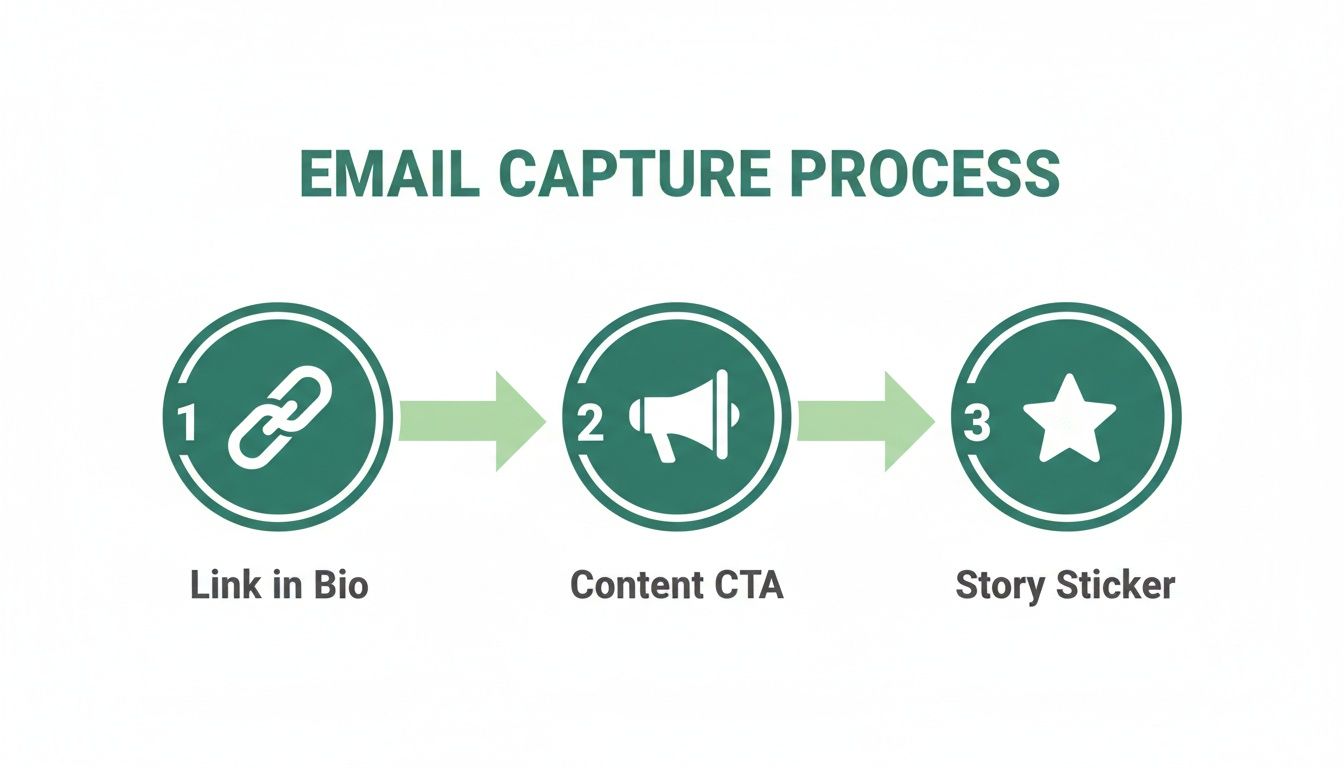
This visual breaks it down perfectly. You're hitting them from all angles: your bio, your main content, and your daily stories. Each one is a doorway to your email list.
Your 7-Day Launch Calendar
Consistency is everything during this launch week. The plan is to talk about your new freebie every single day, but in different ways so your audience doesn't get bored. This approach makes sure your followers see the offer multiple times without it feeling like you're just spamming them.
Days 1-2: The Teaser Phase: Get people curious before you even launch.
- Action Step: Post an Instagram Story poll. Example: "Working on a freebie for you! What’s your biggest struggle with editing photos? A) Finding a style B) Using Lightroom."
- Action Step: Share a behind-the-scenes Reel of you creating the freebie. Just a quick shot of your screen is enough to build buzz. Use a TikTok caption generator for a catchy hook.
Days 3-5: The Launch Phase: Make the big announcement and push hard.
- Action Step: Post a high-value carousel or Reel explaining the freebie. The CTA should be impossible to miss: "Grab it for free—link in bio!"
- Action Step: Go live on Instagram or TikTok to talk about the problem your freebie solves and answer questions in real time.
- Action Step: DM 10 of your most engaged followers a personal note. "Hey! I just dropped a free guide on X and thought of you. Link is in my bio if you want it!" This personal touch is gold.
Days 6-7: The Reminder Phase: Nudge the people who missed it.
- Action Step: Share a screenshot of someone's positive feedback (social proof!) to your Stories.
- Action Step: Post a "Last Chance" style Story with a countdown sticker to create a little friendly urgency.
Don't Forget Your Welcome Sequence
Getting someone to sign up is only the beginning. An automated welcome sequence is how you turn a new subscriber into a true fan. This isn't just about delivering the PDF; it's about rolling out the welcome mat and making an incredible first impression.
Here’s a dead-simple, 2-email sequence you can set up in any email marketing tool:
Email #1: The Instant Delivery (Sends Immediately)
- Subject: Here's your [Lead Magnet Name]!
- Content: Keep this one short and to the point. Thank them for signing up, give them the download link right at the top (don't make them hunt for it!), and give them a quick teaser of what to expect from your future emails.
Email #2: The Connection (Sends 1 Day Later)
- Subject: So, what did you think?
- Content: Now it’s time to start a conversation. Share a quick personal story about why you're so passionate about this topic. Then, ask them a direct question to encourage a reply, like, "What’s the #1 thing you’re struggling with when it comes to [your topic]?"
This simple automation does so much more than just grow a list—it starts to build a real community. And that community is your single most valuable asset. Industry data for 2025 suggests that email marketing can bring in $36–$42 for every $1 spent. Automation is a massive part of that success. For creators, that math is a game-changer, showing how even a small, engaged list can become a reliable source of income.
Your Top Questions About Building an Email List, Answered
Jumping into email marketing for the first time can feel like you're trying to crack a code. It's totally normal to have questions, so let's walk through some of the biggest ones I hear from creators.
How Often Should I Actually Email My List?
This is the big one, isn't it? The truth is, there’s no magic number. But here's what I've learned: consistency beats frequency, every single time.
Whether you decide on a weekly deep-dive, a bi-weekly roundup, or a monthly update, the key is choosing a rhythm you can actually maintain. Showing up reliably in their inbox is far more powerful than sending a flurry of emails one week and then going silent for a month. Your audience will come to anticipate and value that predictability.
What on Earth Do I Send Them? A List of 4 Ideas
Your emails need to feel special—like a backstage pass that isn't available on your public feed. This is your inner circle, so give them the good stuff.
Here are 4 content ideas that always work well for influencers:
- Go behind the scenes: Share the messy, unfiltered story behind a project or a recent post. People love seeing the real process.
- Share exclusive tips: Give them your best advice, the stuff you don't post anywhere else. A fitness creator could share a little-known recovery trick; a designer might reveal a game-changing keyboard shortcut.
- Host subscriber-only Q&As: Let your list ask you anything, then answer their questions in an email. It creates a powerful, direct connection.
- Offer early access and special deals: They should be the first to know about new products, videos, or promotions.
The real goal is to get your emails to inspire action. For a masterclass on crafting emails that get results, I highly recommend reading up on these best practices for higher email conversions.
Is It Too Late to Start an Email List in [Current Year]?
Not a chance. Social media platforms are like rented land—the algorithm can change, or the platform could fade away. Email is the only channel you truly own.
Starting today gives you an asset that will only grow more valuable over time. It’s your direct line to your most dedicated followers, creating a foundation for a stable, long-term business.
But you can't just set it and forget it. A list needs attention. People change emails, switch jobs, or simply lose interest. One study found that email lists can decay by an average of about 28% in a single year. That means almost a quarter of your hard-won subscribers could go cold if you're not actively managing your list.
The best time to start an email list was yesterday. The second-best time is right now. Every subscriber you gain is a step toward a more sustainable and predictable business.
How Do I Keep People Engaged and Keep the List Growing?
Growth isn't about a single big launch; it's about weaving your email list into the fabric of your daily content. Think of it as a constant, gentle invitation.
Mention your freebie in your Reels. Create a dedicated "Get My Guide" Story highlight on Instagram. Every so often, just remind your followers what incredible value they're missing out on by not being on the list.
As your list gets bigger, you can start sending more relevant content by segmenting your subscribers based on their interests. For a deeper look at turning those subscribers into paying customers, you can also check out our guide on turning followers into customers. When you consistently deliver value, you not only keep your current subscribers hooked but also encourage them to share your work with others.