
You've already done the hard work of building a community that knows, likes, and trusts you. That's the real currency you have. Now, it's time to turn that influence into a real, scalable business that earns for you around the clock by creating digital products to sell.
Think of this as your personal playbook for turning all those DMs, comments, and repeat questions into a stream of income.
Why Digital Products Are a No-Brainer for Influencers
As an influencer, you're practically sitting on a goldmine of product ideas. Every single time a follower asks for your morning routine, your go-to video filters, or how you map out your content, they’re literally telling you what they would pay to learn from you. Shifting from relying solely on brand deals to selling your own products puts you in the driver's seat and builds a predictable, reliable income source.
The opportunity here is massive. We're talking about a global digital goods market that's ballooning, with some analysts predicting it will hit a transaction value of around $6–7.5 trillion. With an estimated three billion people expected to shop online, the customers and the technology are already there, waiting for you.
Turning Your Influence into Actual Income
The real beauty of digital products is how scalable they are. Unlike one-on-one coaching, which is limited by your time, or physical goods, which come with inventory headaches, you create a digital asset just once. After that, you can sell it forever with virtually no extra cost per sale. It’s the perfect model for serving more of your community without burning yourself out.
Pro Tip for Influencers: Most creators don’t get stuck because they lack expertise. They get stuck because they don't know what to sell or how to present it. Here's a hint: the best digital products solve a specific, nagging problem your audience is already talking about.
So, What Actually Sells?
You don't need to overcomplicate this. The secret is to align your product with your niche and what your audience is constantly asking for. If you're just dipping your toes in, it's worth taking a moment to learn more about what are digital downloads to see all the possibilities.
For a little inspiration, I put together a quick table outlining some of the most popular and profitable ideas that work incredibly well for influencers.
Top Digital Product Ideas for Influencers
| Product Type | Best For Influencers Who… | Creation Effort |
|---|---|---|
| Ebooks & Guides | …have deep knowledge on a specific topic (fitness, finance, cooking). | Medium |
| Templates & Presets | …are known for a specific aesthetic or workflow (photographers, designers). | Low |
| Planners & Workbooks | …focus on organization, goal-setting, or self-improvement. | Medium |
| Mini-Courses | …can teach a valuable skill in a few focused video lessons. | High |
| Workshops & Webinars | …are great at live teaching and engaging with an audience directly. | Medium |
These are just starting points, but they consistently prove to be winners because they deliver immediate value to your audience. The key is picking the one that feels most authentic to you and your brand.
Finding and Validating Your Perfect Product Idea
The most successful digital products aren't dreamed up in a vacuum. They come directly from listening to what your audience is already telling you, day in and day out. Your comment sections, DMs, and story replies are a goldmine—a literal roadmap to creating something your community is desperate to buy.
Your job isn't to invent a need. It’s to spot the recurring problems and questions that are already there. Seriously, what's that one question you get asked so often you could answer it in your sleep? That’s not an annoyance—it's your next product idea staring you in the face.
3 Steps to Uncover Ideas Hidden in Plain Sight
It's time to become a detective of your own content. Block out an hour and just scroll through your DMs and comments from the last month. You're looking for patterns—repeated questions that tend to fall into a few key buckets.
- Look for "How do you…" questions: These are a dead giveaway for a skill or process you can teach.
- Example: A fitness influencer constantly getting "How do you do a proper push-up?" could easily spin that into a "Perfect Your Form" mini-guide.
- Spot the "Where did you get…" questions: This signals a demand for your resources or tools.
- Example: If you’re a designer and everyone wants to know about your fonts, a "Creator Font Pack" is a no-brainer.
- Listen for "Can you help me with…" questions: These point directly to a struggle your audience wants help overcoming.
- Example: A finance coach who keeps hearing, "Can you help me with my budget?" has a clear mandate to create a "30-Day Budget Makeover" workbook.
Influencer Insight: Many creators make what they want to sell, not what their audience actually wants to buy. The best validation comes straight from your followers' DMs, not from your own assumptions.
This is all about turning those everyday interactions into profitable products.
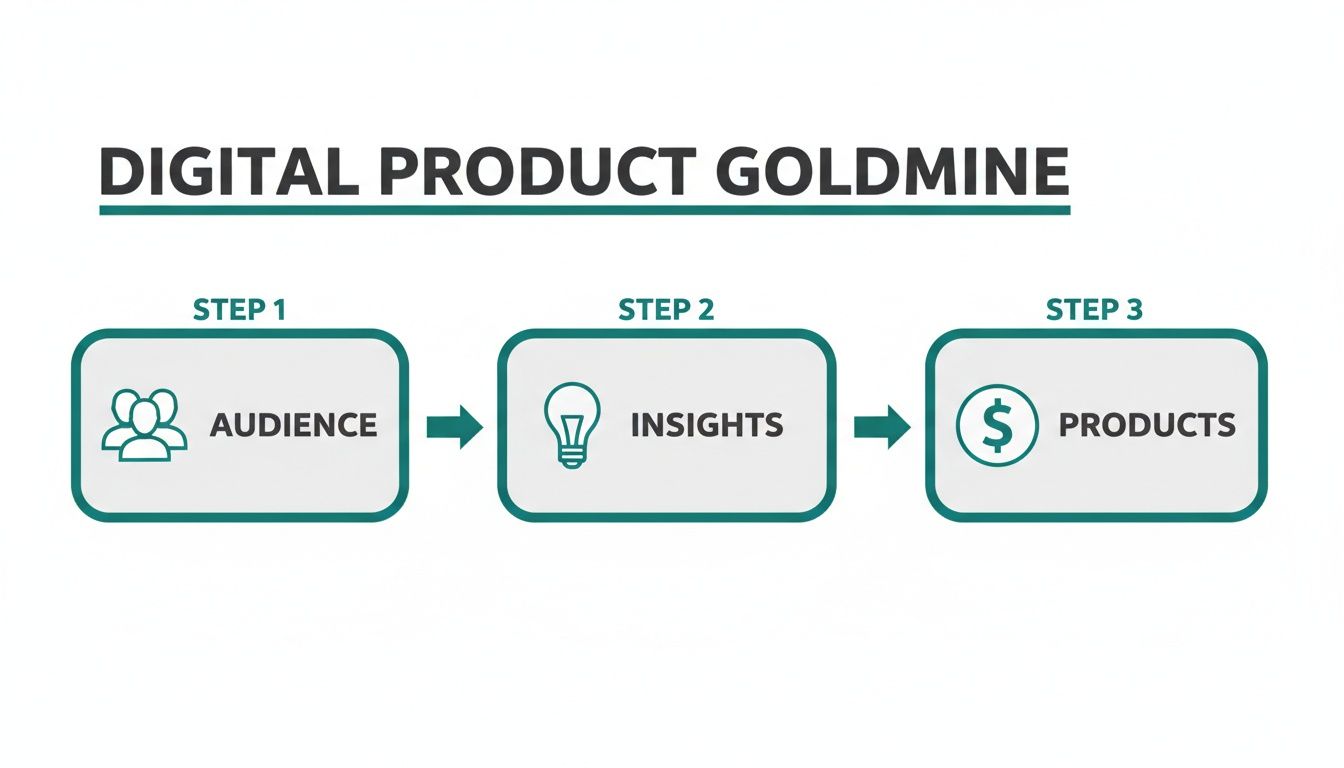
This simple flow—listen to your audience, pull out the key insights, and build products around them—is the foundation of any successful creator business. It’s that simple.
How to Test Your Idea Before You Build It (3 Easy Ways)
Okay, so you have a solid concept. Now comes the most important part: validation. This is the step that saves you from wasting weeks building something nobody wants. Your goal here is to get a clear "yes" from your audience before you invest any significant time or energy.
To get this right, you really need to know who you're building for. Taking the time to create effective buyer personas helps you sharpen your messaging and make sure the final product speaks directly to the right people.
Here are three ridiculously simple, low-effort ways to test the waters:
- Run an Instagram Story Poll: This is the fastest way to get a quick pulse check. Keep it simple: "Thinking of creating a guide on [your topic]. Would you be interested?" A strong "yes" from your most engaged followers is a fantastic sign.
- Create a 'Coming Soon' Waitlist: Use a simple landing page tool to whip up a waitlist. Promote it with something like, "My new [Product Name] is coming! Sign up to be the first to know when it drops." If you get 50-100 sign-ups without much effort, you've got a winner.
- Pre-Sell a Beta Version: This is the ultimate validation. You're asking people to put their money where their mouth is. Offer a limited number of spots for a "beta" version of your product at a discount. If people pay for it before it's even finished, you've officially struck gold.
By validating your idea first, you take all the guesswork out of the equation. You can move forward and build your digital product with the confidence that a hungry audience is already waiting to buy it.
Designing a Product That Feels Premium
Let's be honest: design matters. A lot. It's the first thing people see, and it sends an instant signal about the quality and value of your digital product. A polished, professional look can mean the difference between someone eagerly clicking "buy" and someone scrolling right past.
The good news? You don't need to be a graphic designer or shell out for expensive software to make your product look amazing. The real secret is in the presentation. A simple PDF can be transformed into what feels like a high-ticket program with the right visuals and packaging.
Think about how the creators you admire present their work. They use slick mockups and compelling branding to make their digital products feel tangible and irresistible from the jump.
3 Essential Tools for Non-Designers
Over the years, I've found a few tools that are perfect for creators who need to produce high-quality assets without a massive learning curve. These are my essentials.
- Canva: This is a non-negotiable. It’s perfect for creating beautiful ebook covers, worksheets, and all your social media graphics. The drag-and-drop editor and endless templates let you design a professional-looking guide in less than an hour.
- CapCut or InShot: If you're creating a mini-course or any video content, these mobile apps are fantastic. You can add text, music, and slick transitions right from your phone. Super easy, super fast.
- Smartmockups: This tool is an absolute game-changer for marketing your product. It takes your flat design and places it onto realistic mockups of laptops, tablets, or phones. Suddenly, your PDF looks like a tangible, high-value product people can't wait to get their hands on.
Pro Tip: A well-designed mockup can single-handedly boost your product's perceived value. Instead of just showing a flat image of your PDF, display it on a tablet next to a cup of coffee. This helps your audience actually picture themselves using it and getting results.
How to Craft an Irresistible Offer
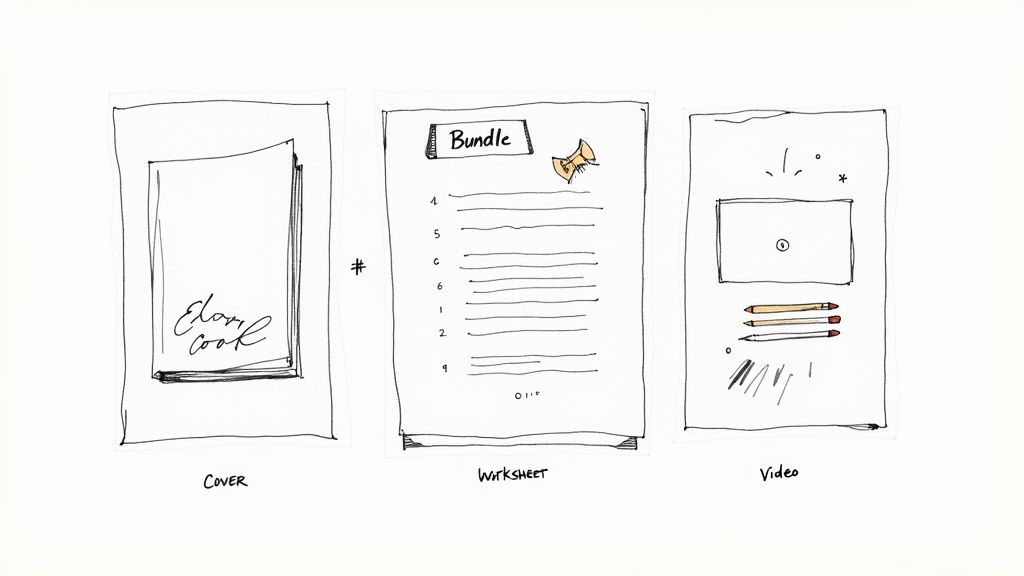
Great design isn't just about the visuals—it's also about how you package the entire offer. Your sales page is your chance to convince your audience that this is the solution they’ve been searching for. One of the best ways to make your offer feel more valuable and increase your average order value is to create a bundle.
Don't just sell a standalone guide; sell a complete solution.
- Example: A "Content Creator Starter Kit" is much more compelling than just a list of ideas. It could include:
- The Main Guide: "30 Days of Instagram Content Ideas" (PDF)
- A Bonus Template Pack: "Canva Reel Cover Templates"
- A Quick Tutorial: "5-Minute Video on Writing Engaging Captions"
This strategy frames your product as a comprehensive system, which easily justifies a higher price while delivering way more value to your customer.

To take things a step further and really make your content pop, you can add interactive elements. For this, I recommend exploring authoring tools like the Lumi H5P Cloud. It lets you build things like quizzes and interactive exercises directly into your guides, making them feel even more premium and hands-on.
Getting Your Pricing and Launch Just Right
You’ve poured your expertise into creating a fantastic digital product. Now for the two parts that often trip people up: putting a price on it and getting it out into the world. Pricing can feel like a shot in the dark, but it doesn't have to be. The real secret is to stop thinking about the hours you put in and start focusing on the transformation you're offering your audience.
What makes digital products so powerful is their financial model. Unlike a t-shirt or a physical book, you create it once and can sell it infinitely. The cost to deliver one more PDF or one more video course is practically zero, which is why gross margins can soar above 80–90%. This incredible profitability means that even a simple paid ad campaign that converts at a modest 1–5% can work wonders.
3 Simple Pricing Models That Actually Work
Forget wrestling with complex spreadsheets and confusing formulas. As a creator, you just need a few solid, straightforward strategies to price your work in a way that feels right for you and makes it an easy "yes" for your followers.
- The One-and-Done Flat Rate: This is your best friend for standalone products like ebooks, guides, or template packs.
- Example: A "30-Day Content Planner" PDF with a simple $27 one-time price. It's clean, easy for customers to understand, and requires no long-term commitment.
- The Tiered "Good, Better, Best" Approach: This works beautifully for mini-courses or more robust bundles.
- Example: A "Basic" course with just video lessons for $49. Then, a "Premium" tier for $97 that includes the videos, access to a private community, and bonus templates. This lets you cater to different budgets.
- The Early-Bird Special: It’s a classic for a reason—it creates genuine urgency.
- Example: For the first 48 hours of your launch, offer a special discount. This rewards your most dedicated followers and gives everyone else a compelling reason to act now.
Pricing Tip: Your price tag is more than just a number; it’s a signal of the value you provide. I see so many creators undercharge. It not only leaves money on the table but can also make potential customers question the quality of your expertise.
If you're looking for a deeper dive, especially for smaller offers, check out our guide on how to price your mini-course for packages that sell.
A 5-Day Launch Plan People Can't Ignore
A successful launch is much more than just a few "buy my thing!" posts. It’s about building a story and creating a wave of excitement that makes your product feel like a must-attend event. Think of your launch week as a mini-campaign that pulls your audience in.
Here’s a simple framework for a week of launch content:
- Monday (The Tease): Let people in on the secret. Use Instagram Stories to show behind-the-scenes action—a sneak peek of a worksheet or a clip from a video. Ask questions like, "What’s your biggest struggle with [your topic]?" to get the conversation rolling.
- Tuesday (The Reveal): Time for the official announcement! Share a polished mockup of your product and finally reveal its name. Your email list should be the very first to know, making them feel like true insiders.
- Wednesday (The Value Bomb): Go live on Instagram or TikTok. Don't just talk about the product; teach something from it. Share a genuinely valuable tip that gives them a taste of the transformation they'll get when they buy. This builds trust.
- Thursday (The Scarcity Angle): Introduce a limited-time launch bonus. Something like, "The first 50 people who sign up will also get my personal Notion workflow template for free!" This is a powerful motivator for fence-sitters.
- Friday (The Last Call): This is all about friendly urgency. Remind your audience that the special early-bird price or the bonus is disappearing soon. Use countdown stickers on your Stories to create a little bit of healthy FOMO (Fear Of Missing Out).
Choosing The Right Platform To Sell Your Product
You've designed an incredible product, and now it's time for the final piece of the puzzle: deciding where to sell it. This isn't a small decision. The platform you choose is going to shape your customer's experience, eat into your profits (or not), and determine how much time you spend on tedious admin tasks.
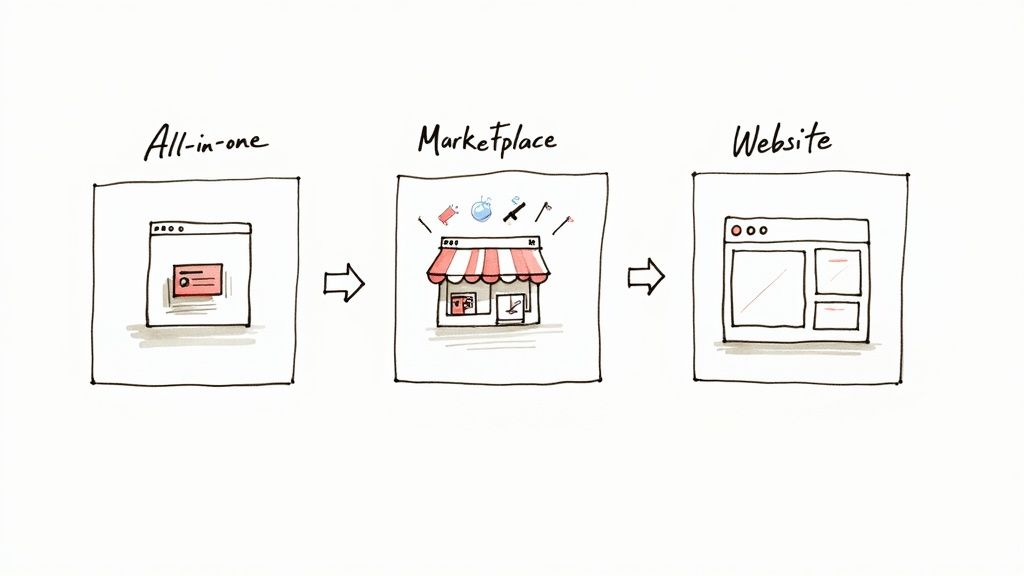
For influencers wanting to create digital products to sell, the choice usually comes down to two main avenues: using an all-in-one platform or listing on a marketplace. Getting this right from the start saves a world of headaches down the road.
All-In-One Platforms Vs. Marketplaces
An all-in-one platform is like setting up your own beautiful, branded storefront. You’re in complete control of the look, feel, and entire customer journey. A marketplace, on the other hand, is like getting a stall in a huge, crowded flea market. You get access to their audience but lose brand control and pay higher fees.
Here are 4 key things to consider when choosing:
- Ease of Use: How fast can you get your product up for sale? Some platforms let you launch a simple guide in minutes.
- Transaction Fees: This one hits the bottom line. Fees can be a flat monthly rate, a percentage per sale, or a mix. A 5% fee adds up surprisingly fast.
- Audience Access: Are you bringing your own audience from social media, or do you need the platform to help find you customers?
- Marketing Tools: What's built-in to help you make sales? Look for essentials like affiliate programs, discount codes, and email list integrations.
Tech Tip: Your platform should make your life easier, not more complicated. The goal is a solution that automates the boring stuff—payment processing, product delivery—so you can stay focused on creating amazing content and connecting with your community.
A Few Top Platform Picks For Influencers
The options out there can feel overwhelming, but a few platforms have really proven themselves for creators. To help narrow it down, here’s a quick comparison of the big players.
Digital Product Platform Comparison
| Platform | Transaction Fees | Best For… | Key Feature |
|---|---|---|---|
| Gumroad | 10% flat (no monthly fee) | Quick & simple launches (ebooks, templates, presets) | Unbeatable ease of use; you can start selling in minutes. |
| Shopify | 2.9% + 30¢ (plus monthly fee) | Building a full brand with multiple digital/physical products | Total customization and scalability for long-term growth. |
| Teachable | 5% – 10% (depending on plan) | Online courses, coaching, and educational content | All-in-one course creation tools (quizzes, certificates). |
This table gives you a snapshot, but remember that the "best" platform truly depends on your specific product and goals. What works for a simple PDF download won't be the right fit for a comprehensive video course.
For a much deeper dive, you can check out our full guide on the best platforms for selling digital products, where we break down even more options.
By carefully matching a platform’s strengths to what you’re selling, you’re not just picking a piece of software—you’re setting the foundation for a smooth, profitable, and successful launch.
Got Questions About Digital Products? Let's Get Them Answered
Jumping into the world of digital products for the first time? It's totally normal to have a few questions swirling around. I've heard them all from creators just like you, so let's tackle the big ones head-on so you can move forward feeling confident.
How Much Money Can I Realistically Make?
This is always the first question, and for good reason! The honest-to-goodness answer is… it depends. I’ve seen creators bring in a few hundred dollars a month, and I've seen others scale to six or even seven figures a year.
Your earning potential really comes down to a few things: the size of your audience, how engaged they are, and most importantly, how well your product solves a real, painful problem for them. The real magic, though, is in the scalability. The effort to sell one copy is almost the same as selling ten thousand. My advice? Stop obsessing over the potential dollar amount and start obsessing over solving one specific problem for your followers. When you nail that, the income follows.
What If Someone Steals My Product?
I get it. The fear of piracy is real, but it absolutely should not paralyze you. The reality is that the overwhelming majority of people are honest. They see the value you provide and are happy to pay for it.
The Hard Truth: The revenue you’ll earn from your legitimate, supportive customers will almost always far outweigh any potential losses from piracy. Focus on building a strong community that wants to support you—that's your best defense.
Don't let the fear of a few bad apples stop you from serving the hundreds or thousands of people who are waiting to learn from you.
Of course, you can take a few simple steps to protect your work:
- Use a secure delivery platform like Gumroad or Podia that can limit downloads.
- Add subtle watermarks or branding to your PDFs and videos.
- Include a clear terms-of-service agreement at checkout.
Do I Need a Huge Following to Succeed?
Nope. Not at all. In fact, I'd argue that a smaller, hyper-engaged niche audience is often way more powerful than a massive, disengaged one. It’s all about the quality of the relationship you have, not the quantity of followers.
Think about it this way: a loyal community of 1,000 followers who genuinely trust your expertise is far more likely to buy a specific, helpful product than a disinterested audience of 100,000. Start right where you are. Serve the people you have right now, and your business will naturally grow from that solid foundation.
Ready to stop guessing what to sell and start building predictable income? Rupa analyzes your unique audience to tell you exactly what digital product to launch, then gives you all the assets to go live in hours, not weeks. Monetize your audience with Rupa.