

Last Updated on 2 days ago by Ilya
The creator economy has expanded far beyond a niche segment, with its value growing from approximately $250 billion to projections of $528 billion, according to Whop. This scale reflects a deeper shift: content creation is increasingly structured as a business model rather than an occasional source of income.
At the same time, a large number of creators continue to rely on platforms they do not control. Social networks provide access to audiences, but the underlying systems remain external. Algorithms change, reach fluctuates, and monetization tools can be adjusted without notice, which directly affects income stability.
As a result, audience size alone does not determine earnings. Two creators with similar reach can generate entirely different levels of income depending on niche clarity, audience trust, and how well their monetization structure aligns with the expectations of their audience.
Sustainable income emerges when attention is converted into a structured system of revenue streams, where different monetization models complement each other instead of competing for the same audience.
Why Audience Size Alone Does Not Explain Creator Income
Follower count remains one of the most visible metrics in the creator economy, but it is also one of the least reliable indicators of earning potential. A large audience can create the impression of commercial strength, yet visibility alone does not guarantee that people trust the creator, understand the offer, or feel a reason to spend money. In practice, monetization depends less on how many people see the content and more on how the audience responds to it.
This difference becomes especially clear when comparing broad-reach content with niche influence. Wide reach often produces scattered, short-lived attention, while a more focused audience tends to generate more consistent economic value. The ability to turn attention into income depends on several key factors:
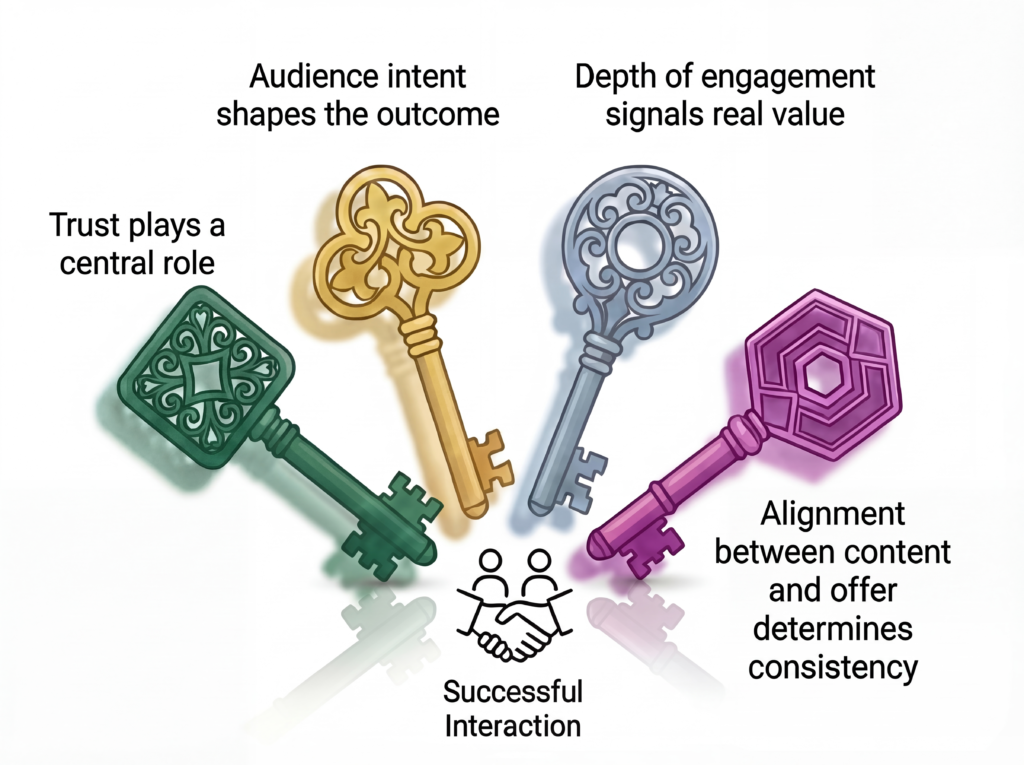
- Trust plays a central role — repeated exposure alone does not lead to purchases. People take action when the creator is perceived as a reliable source within a clearly defined niche. In areas such as education, finance, or software, this trust often becomes the foundation for higher-value transactions.
- Audience intent shapes the outcome — content built around problem-solving, such as tutorials or comparisons, attracts people who are already closer to making a decision. Entertainment-driven content, by contrast, often results in passive consumption with lower commercial readiness.
- Depth of engagement signals real value — a smaller audience that saves content, asks questions, and returns regularly often carries more economic weight than a larger audience that interacts only superficially.
- Alignment between content and offer determines consistency — reach creates opportunity, but income depends on whether the monetization model naturally extends from the creator’s expertise and audience expectations.
Consider an example. A creator may attract millions of views through viral short-form content but struggle to sell a $15 product because the audience is broad and loosely connected to a specific need. At the same time, a creator with 15,000 subscribers in a focused niche can generate $15,000 per month by offering a specialized product to an audience that clearly understands its value. The difference lies not in reach, but in trust, intent, and alignment.
The Main Categories of Creator Income
Creator income becomes easier to understand when it is grouped into categories rather than treated as a loose collection of tactics. The main difference between these categories lies in control — who sets the rules, how stable the income is, and how much influence the creator has over pricing, access, and long-term growth.
| Income Category | Who Controls It | Stability | Growth Potential |
|---|---|---|---|
| Platform-Dependent Income | The platform | Medium to low | Medium |
| Brand-Dependent Income | The brand and market demand | Medium to low | Medium to high |
| Audience-Direct Income | The creator | High | High |
| Performance-Based Income | The creator and user action | Medium | Medium to high |
Platform-Dependent Income
This category includes revenue generated through the internal tools and rules of a platform, such as YouTube AdSense, TikTok’s updated creativity programs, or Instagram’s seasonal incentive bonuses. These programs are often accessible and visible, especially for creators in the early stages of monetization.
At the same time, they are also among the most volatile sources of income. Creators do not control payout logic, eligibility thresholds, or algorithm changes. Platform-based monetization can work as a supporting layer of revenue, but relying on it as a primary source leaves the business exposed to external shifts.
Brand-Dependent Income
Brand-dependent income appears when a company pays a creator for access to audience attention, trust, or niche relevance. This category includes sponsored posts, integrated campaigns, ambassador partnerships, and longer-term collaborations.
These deals can generate meaningful revenue, but they are rarely fully predictable. Brand budgets, campaign timing, and market priorities all influence availability. Success in this category depends on the creator’s ability to demonstrate relevance, audience fit, and commercial value to external partners.
Audience-Direct Income
This is one of the most resilient models in the creator economy because it is built around a direct commercial relationship with the audience. Revenue comes from products, services, subscriptions, communities, or other offers controlled by the creator.
Because the creator controls the offer, the price, and the customer relationship, this model is less affected by platform changes. Digital products, paid communities, and subscription-based access can turn followers into a more stable customer base and give the creator greater control over long-term growth.
Performance-Based Income
Performance-based models connect income to a measurable action, such as a purchase, sign-up, or referral. Affiliate marketing and referral programs are the most common examples.
This model works especially well when the creator understands audience intent and produces content that supports decision-making. Unlike brand deals, which often pay for exposure, performance-based income depends on results. When the content remains relevant, it can continue generating revenue over time.
Brand Sponsorships and Partnerships
Sponsorships and brand partnerships remain one of the most visible income streams in the creator economy. Brands no longer evaluate creators only through raw reach. They look at niche relevance, audience trust, and the likelihood that a recommendation will lead to measurable action.
A sponsorship is not simply a paid placement. It is a form of borrowed credibility. When a creator integrates a brand into their content, they are effectively extending their authority to that product or service. That is why long-term partnerships often carry more value than one-off posts: repetition strengthens trust and makes the commercial message feel more natural.
This shift also changes what brands are actually buying:
- targeted relevance — access to a specific audience that is difficult to reach through broad advertising
- creative production — content that feels native to the platform rather than inserted into it
- trust and validation — endorsement that carries more weight than a brand speaking about itself
Consider an example. A creator with 40,000 followers in a narrow wellness niche may appear smaller than an entertainment account with 300,000 followers. Yet if the first creator regularly receives detailed questions, saves, and replies under product-related content, a wellness brand may view that audience as commercially stronger. The difference lies not only in size, but in trust, fit, and the probability of action.
According to Later, micro influencers often generate stronger returns for brands because their recommendations feel more personal and less like commercial interruption. This helps explain why smaller creators can still compete successfully for sponsorship budgets when their audience is highly aligned with a product category.
At the same time, sponsorship income is rarely stable enough to function as a complete business model on its own. Brand budgets change, campaign timing shifts, and demand can fluctuate across seasons. For that reason, partnerships are most effective when they sit inside a broader revenue structure rather than carrying the entire business alone.
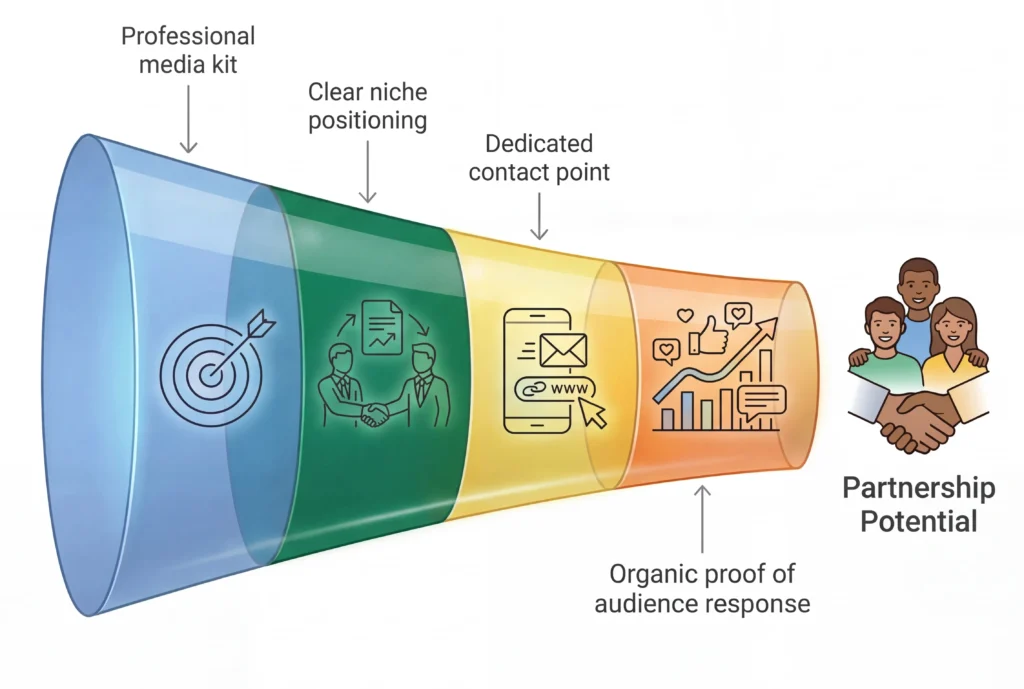
- Professional media kit — helps a brand quickly assess niche fit, content format, engagement patterns, and past work. It reduces friction at the first point of contact and makes commercial conversations easier to start.
- Clear niche positioning — gives brands immediate clarity. It should be obvious who the audience is, what topics define the content, and why that audience is commercially relevant.
- Dedicated contact point — signals readiness for professional communication. A visible business email or a creator hub link makes outreach easier and separates partnership inquiries from casual audience interaction.
- Organic proof of audience response — can be the strongest signal of all. When content shows saves, detailed comments, repeated questions, or active responses to recommendations, it suggests that trust already exists — and that trust is what brands are trying to access.
Affiliate Marketing as a Conversion-Based Revenue Stream
Affiliate marketing ties income directly to measurable actions. Unlike sponsorship deals, which often pay for exposure, affiliate models pay for outcomes. This makes affiliate income especially valuable for creators whose content reaches people already comparing options, evaluating products, or looking for practical solutions.
According to Later, this accessibility makes affiliate marketing one of the most common monetization methods, especially for creators in the early stages of growth who may not yet have the reach for major brand deals.
One of the main strengths of affiliate marketing is that it can turn content into a long-term commercial asset. A sponsored post may disappear quickly in a social feed, while reviews, tutorials, comparisons, and curated recommendations can continue generating revenue over a much longer period. This is particularly true on search-driven platforms such as YouTube, Pinterest, or blogs, where users often arrive with a specific problem or purchase decision already in mind.
Several factors usually determine whether affiliate content performs well:
- contextual fit — the recommendation should feel like a natural response to the problem discussed in the content
- content longevity — evergreen material can continue attracting new users long after publication
- platform breadth — networks such as Amazon Associates, ShareASale, CJ Affiliate, and Impact make it easier to match offers with audience demand
Consider an example. A creator publishes a detailed comparison of microphones for beginner podcasters. The content does not go viral, but it continues attracting people who are actively choosing between models. If affiliate links are placed naturally within that guide, the same piece of content can generate commissions over time because it stays close to the moment when a buying decision is being made.
This is what makes affiliate marketing a durable part of a diversified income structure. When useful content is aligned with a real audience need, affiliate revenue does not depend only on short-term attention. It can continue working as long as the content remains relevant and discoverable.
Platform Monetization and Revenue Sharing
Platform monetization remains one of the most accessible entry points for creators. Programs such as YouTube AdSense, TikTok’s updated creativity programs, and periodic Instagram bonuses allow platforms to share part of their advertising revenue with the people who attract and retain audience attention. At the same time, this is often one of the least stable income streams in a creator business.
The main limitation of platform-based income is lack of control. In this model, the creator participates in a system whose payout logic is shaped by external rules. Changes in algorithms, monetization requirements, content policies, or advertising demand can all affect earnings, even when output remains consistent.


Several features define this model:
- algorithmic dependence — income is closely tied to distribution, reach, and the platform’s internal ad-matching systems
- low margin at the unit level — payouts per view are usually modest, which means meaningful revenue often requires large and steady traffic
- geographic sensitivity — advertising rates vary by market, so audience location can significantly influence earnings
- limited pricing power — the creator does not set the payout structure and has little influence over how revenue is calculated
Because of these limits, platform monetization works best as a supporting layer rather than a complete business model. It can help fund production, reward scale, and provide baseline income, but the strongest creator businesses usually treat it as secondary to more controlled revenue streams such as products, subscriptions, or direct audience offers.
Selling Digital Products and Owned Offers
Digital products represent one of the most controlled and scalable revenue models in the creator economy. Instead of relying on external payouts, creators generate income through their own offers — products that can be refined, expanded, and sold directly to their audience.
This model shifts the focus from monetizing attention to owning a structured offer. Content no longer exists only to attract views. It becomes a distribution layer that leads to a product, where the creator controls pricing, access, and the overall customer experience.
According to Whop, creators who build owned products tend to achieve more stable and predictable income than those relying only on sponsorships or platform monetization.
Digital products can take several forms:
- guides and educational materials
- templates and digital tools
- workshops and masterclasses
- structured courses
- paid communities or access-based content
The strength of this model lies in both control and margin. Once a product is created, it can be sold repeatedly without proportional growth in costs. This allows creators to scale revenue without depending on algorithm changes or external demand cycles.
A typical product structure often develops in layers:
- entry-level offer — a simple product that validates demand
- core product — a deeper solution to a specific problem
- premium offer — advanced access, support, or a more personalized experience
Consider an example. A creator producing design tutorials may begin with free content. Over time, this can evolve into a paid template pack, then into a structured course, and eventually into a premium program with direct feedback. Each layer increases both value and revenue stability.
Here are some of the leading platforms creators use to sell their offers:
| Platform | Key Advantage | Best For |
|---|---|---|
| Rupa | Combines courses, consultations, and digital products in one system, making it easier to manage offers, payments, audience access, and monetization flows without relying on multiple disconnected tools. | Creators who want an all-in-one setup for selling different types of offers while keeping the sales process organized and easier to scale. |
| Fourthwall | Allows creators to combine digital products with branded physical merchandise. | Creators who want to sell both downloads and merch in one storefront. |
| Gumroad | Makes it easy to sell individual files and small digital products with minimal setup. | Independent creators with simple digital offers such as guides, templates, or assets. |
| Shopify | Provides the strongest control over store structure, checkout, and brand presentation. | Larger creators building a full e-commerce business around their audience. |
The key distinction of this model is ownership. When a creator controls the product, the pricing, and the customer relationship, income becomes less dependent on external systems and more closely tied to the value being delivered.
Memberships, Communities, and Recurring Revenue
Recurring revenue helps protect creators from the income volatility that often comes with brand deals, ad payouts, and platform changes. Memberships create a more stable financial base because they depend on an ongoing relationship with the audience rather than on one campaign or one spike in reach.
The strength of this model lies in commitment. A subscription works only when the creator offers continuous value — whether through exclusive insights, direct access, early releases, or a stronger sense of belonging. In that sense, the goal is not to maximize audience size, but to build a smaller group of supporters willing to stay over time.
This makes memberships especially valuable for creators who want to reduce dependence on virality. A dedicated community can be more sustainable than a large but inconsistent audience, because retention matters more than short-term attention.
Leading platforms for memberships and communities include:
| Platform | Key Advantage | Best For |
|---|---|---|
| Patreon | Strong support for tiered memberships and gated rewards. | Creators who want structured member benefits and exclusive content. |
| Substack | Combines paid subscriptions with direct newsletter distribution. | Writers and educators building recurring revenue through email. |
| Circle | Provides organized, searchable community spaces. | Creators building more structured communities beyond chat-based formats. |
| Ko-fi / Buy Me a Coffee | Offers an easy entry point for recurring support. | Creators who want lightweight memberships or small ongoing contributions. |
The long-term success of this model depends on retention. Keeping an existing member is usually more efficient than constantly replacing them. That is why strong membership models focus not only on content, but also on the overall experience — for example, monthly Q&As, early access, or member-only participation in future decisions.
Services, Consulting, and UGC Work
Direct services are often one of the fastest ways for creators to generate meaningful income, even with a relatively small following. Instead of waiting for ad revenue or sponsorships to grow, creators can monetize professional skills through higher-margin offers. Two of the strongest directions in this category are consulting and UGC.
Consulting allows creators to monetize authority through audits, one-on-one sessions, or strategic guidance for brands and other creators. UGC works differently: here, the creator is not selling access to an audience, but the ability to produce content that brands can use in their own marketing. According to Influencer Marketing Hub, 31% of brands rank UGC as highly effective, which helps explain why this model continues to grow.
Key revenue channels include:
- UGC creation — producing short-form videos, product demonstrations, and ad-ready content for brands
- Strategic consulting — helping brands or other creators improve content strategy, positioning, or technical setup
- Specialized services — offering high-value execution such as video editing, scriptwriting, design, or AI-assisted creative production
What makes these models especially valuable is that they allow creators to monetize capability before they fully monetize scale. Income can grow not only because the audience becomes larger, but because the creator’s skill becomes more commercially useful.
A Practical Monetization Path for Different Growth Stages
Monetization does not begin all at once. It develops step by step as a creator gains audience trust, sharper positioning, and more control over their offers. The most practical approach is to match revenue priorities to the current stage of growth rather than trying to launch everything at the same time.
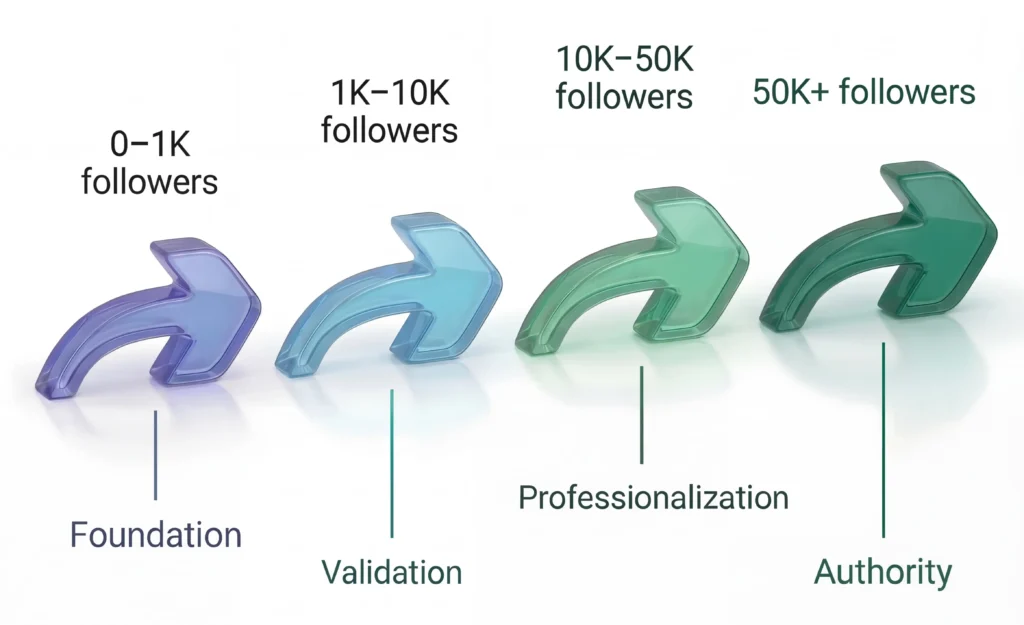
At the Foundation stage (0–1K followers), the priority is not aggressive monetization but audience learning. This is the stage for building content habits, identifying what resonates, and creating the first points of contact. Platforms like Rupa can be integrated even here to start building an owned audience through email capture or lightweight lead magnets, ensuring the creator owns the relationship from day one.
At the Validation stage (1K–10K followers), direct services often become the most realistic source of income. UGC and one-on-one consulting can work even before a creator has large reach, because brands and clients are paying for execution or expertise rather than scale alone. This is also where creators start automating these service bookings and payments through their centralized hub (like Rupa), reducing the administrative friction of manual outreach.
At the Professionalization stage (10K–50K followers), digital products usually become more viable. Once a creator has a clearer niche and a more responsive audience, guides, templates, mini-courses, or structured paid offers can begin turning expertise into revenue that is less tied to hours worked. Platforms such as Rupa can support this stage by helping creators organize products and access in one place.
At the Authority stage (50K+ followers), memberships and communities become easier to sustain. A larger and more established audience makes recurring revenue more realistic, which can support deeper investment in content quality, operations, and long-term business growth.
Conclusion
A sustainable career in the creator economy begins when content stops functioning only as a source of attention and starts working as a structured source of income. As monetization develops — from services and UGC to digital products and recurring memberships — creators gain more control over both revenue and creative direction.
The real advantage of this shift is not only growth, but resilience. The more income depends on owned offers and direct audience relationships, the less exposed the business becomes to algorithm changes, platform decisions, or shifts in brand demand.
That is why the strongest path is usually gradual. Creators start with the assets they already have, choose the model that matches their current stage, and build stronger ownership over time.