

A blog does not need banner ads, pop-ups, or display networks to generate income. In many cases, monetization without ads gives the blogger more control because revenue depends less on page views and more on the value of the content, the relevance of the offer, and the trust of the audience. Instead of earning from attention alone, a blog can earn by helping readers solve problems, make decisions, or gain access to something useful.
This approach changes the role of the blog itself. It stops being just a traffic channel and becomes part of a monetization system. Articles attract readers, useful content builds trust, and that trust can then lead to product sales, service inquiries, paid subscriptions, or partner conversions. In this model, income is connected not to advertising space, but to the relationship between the blog, its audience, and the offer behind it.

That is why many bloggers choose to monetize without ads. This model can be cleaner for the reader, more aligned with expert content, and often more flexible in the long term. The key is not simply to remove advertising, but to replace it with a monetization structure that fits the blog’s niche, content format, and audience behavior.
How to Monetize a Blog
Traditional advertising is no longer the only way for a blog to generate income. Banner ads, pop-ups, and display networks can bring revenue, but they also make earnings dependent on traffic volume, ad rates, and external platforms. For many blogs, especially in expert or niche spaces, this creates a weak and unstable foundation.
Monetization without ads works differently. In this model, the blog does not earn by selling space on the page. It earns by connecting useful content to something more valuable: a product, a service, paid access, or a trusted recommendation. That changes the role of the blog itself. Articles stop being just isolated pieces of content and start working as entry points into a larger revenue system.
This is why ad-free monetization usually develops through a small number of stronger paths rather than through one universal method. The blog attracts attention through useful content, builds trust through expertise, and then turns that trust into action through a relevant offer. The main models below follow this logic in different ways.
The main monetization paths usually include:
- Digital products — selling guides, templates, courses, and other structured resources.
- Services — converting blog expertise into consulting, audits, strategy sessions, or implementation work.
- Affiliate recommendations — earning from useful product or service recommendations inside articles.
- Sponsored content — working with brands through native placements and paid integrations.
- Paid access — offering premium articles, closed archives, newsletters, or private communities.
Selling Your Own Digital Products
Selling digital products allows a blog to move from explaining ideas to providing structured solutions. Free content helps the reader understand a topic, while a paid product organizes that knowledge into a clear and practical format. This makes digital products a natural extension of blogs that educate, compare, or guide — the blog attracts attention, and the product converts it into value.
This model is scalable because the main effort is concentrated at the creation stage. Once a product is built, it can be sold repeatedly without increasing workload in proportion to demand. According to Statista, the global e-learning market is projected to exceed $400 billion, reflecting growing demand for structured, self-paced solutions rather than fragmented information.
Common formats of digital products include:
- Guides and ebooks — structured materials that explain a topic step by step. For example, an ebook called «How to Organize a Jewelry Catalog for SEO.»
- Templates and checklists — ready-to-use tools for immediate application. For example, a blog post checklist for publishing SEO-ready articles.
- Courses — structured programs that guide users through a process. For example, a course on building a content plan for a niche blog.
- Digital tools — practical assets that simplify specific tasks.
For example, a content calendar spreadsheet with automated planning fields. - Resource packs — bundled collections of reusable materials built around one task or workflow. For example, a blog monetization pack with CTA templates, landing page copy prompts, and offer-page examples.
Platforms used to create and sell digital products vary significantly in their structure, level of complexity, and the type of monetization they support. Some tools are designed for quick and simple sales with minimal setup, while others provide a more advanced ecosystem that includes course delivery, client management, email marketing, and automation. The choice of platform usually depends on whether the blog focuses on single digital products, structured learning experiences, or a broader knowledge-based business built around multiple offers.
| Platform | Best for | Main advantage |
|---|---|---|
| Rupa | All-in-one creator monetization | Combines digital products, courses, and consultations in one system, acting as a single conversion hub for a blog. |
| Gumroad | Simple digital product sales | Easy to launch and sell ebooks, courses, and files with minimal setup. |
| Shopify | Full-scale storefront | Strong control over store structure, checkout, and product management; supports digital sales. |
| Thinkific | Course-based monetization | Built for structured learning with course delivery and student management. |
| Teachable | Mixed learning formats | Supports courses, coaching, and downloads in one platform. |
| Kajabi | All-in-one knowledge business | Combines products, email marketing, automation, and sales funnels in one system. |
Offering Services Through Blog Expertise
A blog can work as ongoing proof of expertise, turning content into a direct path to services. In this model, articles do more than inform. They show how the author approaches problems, analyzes situations, and builds solutions, so the blog becomes a practical demonstration of competence. This is what allows content to support the sale of specialized services rather than function only as a traffic source.
Unlike ad-based models, service monetization does not depend on very large audiences. It can work effectively even with lower but highly targeted traffic, because a single consultation, audit, or implementation project may generate more revenue than a large volume of ad impressions. The key difference is that the reader is no longer paying for access to information. They are paying for applied expertise, direct input, and a result-oriented working process.
Common service formats include:
- Consulting — direct expert advice tailored to a specific situation. For example, a 60-minute consultation on improving blog monetization strategy.
- Audits — structured analysis with recommendations. For example, a full review of a blog’s SEO structure and content performance.
- Strategy sessions — focused planning and decision-making support. For example, a session to define positioning and choose the right monetization model.
- Implementation services — hands-on execution of tasks. For example, setting up a content system or optimizing a product funnel.
- One-on-one support — ongoing guidance over time. For example, monthly support with feedback, revisions, and progress tracking.
The tools used in this model usually cover three things: presenting the offer, booking the session, and collecting payment.
| Platform | Best for | Main advantage |
|---|---|---|
| Rupa | Service + product setup in one place | Useful when a blog leads readers to both consultations and digital offers, because it combines coaching, products, and courses in one hub. |
| Calendly | Scheduling sessions | Simplifies booking by automating availability, calendar syncing, and meeting setup. |
| Stripe | Direct payments | Works well for accepting service payments through a flexible online payment system. |
| PayPal | Familiar checkout | Useful for bloggers who want a widely recognized payment option for clients in different markets. |
| Superpeer | Paid calls and ongoing access | Fits creators who want to sell one-on-one sessions and, if needed, add recurring paid access around their expertise. |
Affiliate Recommendations Inside Blog Content
Affiliate monetization allows a blog to earn not from impressions, but from user actions. Instead of placing banners, the blog integrates recommendations directly into content, and revenue is generated only when the reader clicks, signs up, or makes a purchase. This makes affiliate income closely tied to intent — it works best when the audience is already searching for solutions or comparing options.

This model is especially effective in evergreen content. Articles that answer specific questions or support decision-making can continue attracting targeted traffic over time. According to Influencer Marketing Hub, affiliate marketing spending is projected to reach over $15 billion globally, which reflects its role as a performance-driven monetization channel. When content aligns with real user needs, affiliate links can generate consistent income long after publication.
Common formats where affiliate recommendations perform well include:
- Product reviews — detailed analysis of a specific product. For example, a review of blogging tools for beginners.
Comparisons — side-by-side evaluation of options.For example, comparing different email marketing platforms. - Tutorials — step-by-step guides that include tools. For example, a guide on setting up a blog with recommended services.
- «Best tools» articles — curated lists for a specific use case. For example, a list of best SEO tools for small blogs.
- Recommendation pages — structured collections of trusted tools. For example, a dedicated page with all recommended resources.
Affiliate programs and networks connect blogs with products and services that match their audience:
| Platform | Best for | Main advantage |
|---|---|---|
| Amazon Associates | General product recommendations | Wide range of products and easy entry. |
| ShareASale | Multiple brands and niches | Large marketplace with diverse offers. |
| CJ Affiliate | Established affiliate programs | Access to well-known brands. |
| Impact | SaaS and digital services | Strong tracking and partnership tools. |
| PartnerStack | B2B and SaaS products | Focus on recurring commission models. |
| Rakuten Advertising | Global affiliate network | Access to international brands. |
Sponsored Articles and Native Integrations
Sponsored content is a model where a brand pays for placement or integration inside an article, regardless of user actions. Unlike affiliate marketing, income does not depend on clicks or conversions. Instead, the value comes from access to the blog’s audience and the trust it has built. This approach works best when the brand fits naturally into the blog’s topic, so the integration feels relevant rather than forced.
Platforms that help connect creators with brands and manage collaborations include:
| Platform | Best for | Main advantage |
|---|---|---|
| Upfluence | Influencer campaigns | Data-driven brand collaborations. |
| Aspire | Creator-brand partnerships | Focus on long-term relationships. |
| CreatorIQ | Enterprise influencer marketing | Advanced analytics and management. |
| Modash | Influencer discovery | Large creator database and filtering. |
| Influencity | Campaign management | End-to-end influencer marketing tools. |
Because affiliate recommendations and sponsored articles often appear in similar types of content, they are easy to confuse. In practice, however, they differ in how income is generated, how predictable it is, and what role the content plays in the monetization process.
| Criteria | Affiliate Recommendations | Sponsored Articles |
|---|---|---|
| Payment model | Based on user action (click, sale, signup) | Fixed payment from brand |
| Income stability | Depends on performance | Predictable per deal |
| Content role | Helps user choose or solve a problem | Integrates brand into content |
| Trust factor | High when recommendation is relevant | Depends on brand fit and transparency |
| Long-term potential | High (evergreen content can earn over time) | Usually short-term (campaign-based) |
| Example | A comparison article with affiliate links to blogging tools | A paid article featuring a brand’s product inside the content |
Paid Access and Premium Content
Paid access is a model where part of the content remains free, while deeper or more specialized materials are placed behind a paywall. Instead of monetizing through ads or one-time purchases, the blog generates income by offering ongoing access to valuable content, insights, or community. This shifts the focus from single transactions to long-term relationships with readers.
This model works best when the blog consistently delivers high-value content that readers are willing to return to. According to Substack, top newsletter creators generate recurring revenue through subscriptions rather than traffic volume, which shows that audience loyalty can be more important than reach. Paid access is especially effective in niches where information is regularly updated, contextual, or difficult to find in one place.
Common formats of paid access include:
- Premium articles — extended or more in-depth versions of free content. For example, advanced guides available only to subscribers.
- Closed content sections — restricted areas of the blog. For example, a members-only knowledge base or archive.
- Paid newsletters — recurring subscriber-only emails with additional value. For example, weekly insights or curated industry analysis.
- Archive access — full access to accumulated materials. For example, complete access to past articles, guides, and resources.
- Private communities — closed spaces for discussion and interaction. For example, a private group with discussions and direct feedback.
Platforms used for paid access and membership models focus on content delivery, subscriptions, and community management:
| Platform | Best for | Main advantage |
|---|---|---|
| Patreon | Membership and subscriptions | Supports recurring payments and community perks. |
| Substack | Paid newsletters | Combines content publishing and subscription model. |
| Circle | Private communities | Strong tools for managing paid communities. |
| Ghost | Content + membership | Blog platform with built-in subscriptions. |
| Memberstack | Website memberships | Adds paywalls and user access to websites. |
| Ko-fi | Support and small payments | Simple setup for subscriptions and donations. |
Each monetization model solves a different problem. Some work better when the blog attracts search traffic, others depend more on trust, direct relationships, or repeat engagement. The real difference lies not only in the source of income, but also in how much control the blogger has over pricing, access, and long-term growth.
Comparison of Blog Monetization Methods Without Ads
| Criteria | Digital products | Services | Affiliate recommendations | Sponsored articles | Paid access |
|---|---|---|---|---|---|
| How income is generated | Income comes from selling structured assets such as guides, templates, courses, tools, or resource packs. | Income is generated through consultations, audits, strategy sessions, implementation, or ongoing support. | Income depends on user actions such as clicks, sign-ups, or purchases through affiliate links. | Income comes from fixed payments for featuring a brand or integrating it into content. | Income is generated through subscriptions or recurring payments for access to premium content or community. |
| What the blog is really selling | A packaged solution that organizes knowledge and helps the reader achieve a result. | Direct access to expertise, decision-making, and practical problem-solving. | Curated recommendations that reduce decision-making effort. | Access to the blog’s audience and the trust built around it. | Ongoing access to deeper insights, continuity, and exclusive materials. |
| Best fit for | Educational blogs, niche expertise, structured knowledge topics. | Blogs where readers need tailored, situation-specific help. | Search-driven blogs where users are actively comparing tools or solutions. | Blogs with clear positioning and a brand-relevant audience. | Blogs with loyal readers and repeat engagement. |
| Main strength | High leverage: one product can be sold repeatedly without proportional effort. | Fast revenue generation even with low but targeted traffic. | Evergreen content can generate income over a long period. | Higher revenue per deal compared to most other models. | Recurring revenue and stronger long-term stability. |
| Main limitation | Requires upfront creation effort and strong product-market fit. | Limited by time, availability, and delivery capacity. | Dependent on external programs and conversion rates. | Income is less predictable and depends on brand demand. | Requires strong retention and consistent value delivery. |
| Time to first income | Medium — requires time to build and validate the product. | Fast — possible to earn with the first client. | Medium — depends on traffic and intent. | Medium to fast — depends on positioning and outreach. | Slow — requires building a base of paying subscribers. |
| Scalability | High — especially for evergreen products. | Low to medium — constrained by time unless systemized. | Medium to high — scales with traffic and rankings. | Medium — often campaign-based, not compounding. | Medium — depends on retention and audience growth. |
| Level of control | High — full control over pricing, structure, and delivery. | High — full control over offer and pricing. | Medium — control over content, but not over affiliate terms. | Medium — shared control with brands. | High — full control over access, pricing, and structure. |
| Content formats that support it best | Tutorials, deep guides, structured learning content, lead magnets. | Case studies, expert breakdowns, audits, opinion-based content. | Reviews, comparisons, tutorials, “best tools” articles. | Native integrations, thematic articles, brand-aligned content. | Premium articles, newsletters, archives, private communities. |
| Example | A blog sells a structured course or template pack after attracting readers with educational content. | A blog converts readers into consulting clients or audit customers. | A tutorial recommends tools and earns commissions from sign-ups. | A blog publishes a paid article featuring a relevant product. | A blog offers paid weekly insights or a members-only knowledge base. |
Even when the differences between monetization models are clear, the outcome still depends on how the content itself is structured. The same model can produce completely different results depending on positioning, depth, and how well the content aligns with what the audience is actually trying to solve. In practice, monetization is not a separate layer — it is a direct extension of content strategy.
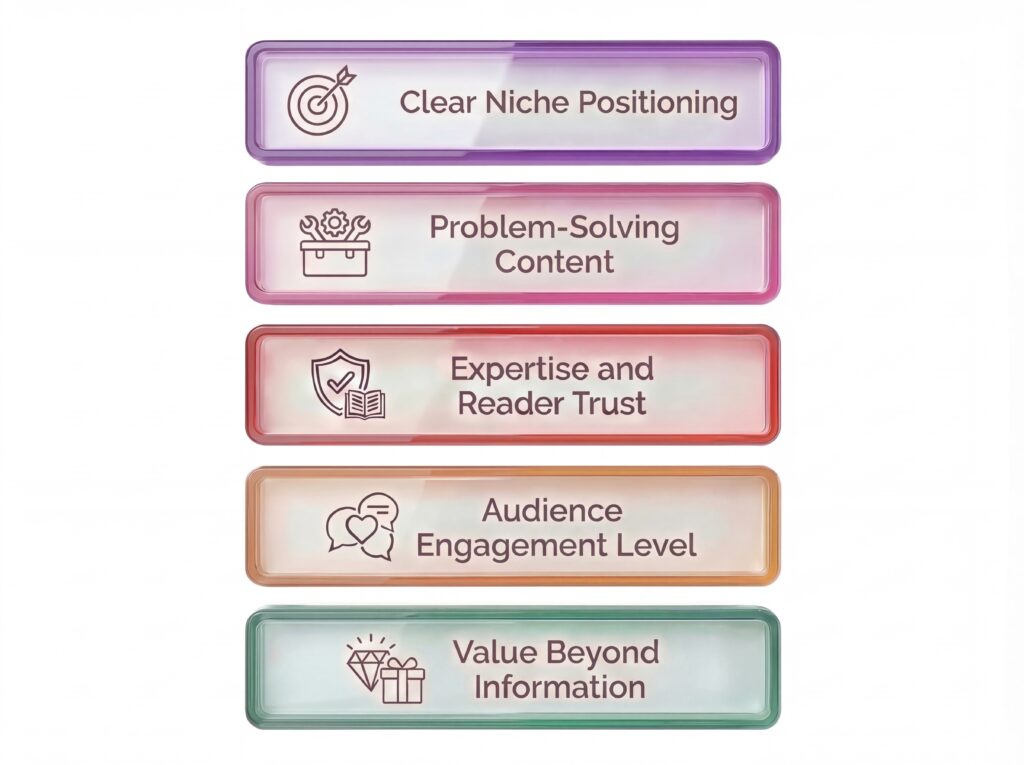
Each point in this checklist reflects a condition that shapes whether a blog can monetize effectively without ads. These elements do not work in isolation. They reinforce one another and together determine whether content can support a sustainable revenue model.
- Clear Niche Positioning — monetization becomes easier when the blog is clearly associated with a specific topic, audience, or type of problem. Strong positioning helps readers understand why the blog is relevant to them and helps products, services, or paid access feel more natural rather than forced.
- Problem-Solving Content — content that addresses real questions, decisions, or practical tasks creates stronger monetization potential than general informational material. Readers are more likely to convert when the blog helps them move toward a solution rather than simply consume information.
- Expertise and Reader Trust — trust is what allows a blog to sell without relying on ads. Readers need to feel that the author understands the topic, applies consistent logic, and can offer something worth paying for. Without trust, even useful content may generate attention without generating revenue.
- Audience Engagement Level — engagement shows whether the audience is passive or genuinely involved. Repeat visits, saves, comments, replies, and questions all indicate that the blog is building a relationship rather than just collecting page views. Higher engagement usually signals stronger monetization readiness.
- Value Beyond Information — the strongest monetization usually appears when the blog offers something beyond free knowledge. This may be structure, speed, implementation, access, support, or a more complete solution. In other words, revenue grows when the blog delivers not only information, but also usable advantage.
Conclusion
Monetizing a blog without ads is not about removing banners — it is about changing the logic of how value is created and delivered. Instead of selling attention, the blog begins to operate as a system where content builds trust, and trust supports a clear and relevant offer.
The most effective monetization models are not chosen based on trends, but on how well they align with the blog’s niche, content structure, and audience behavior. When these elements work together, monetization becomes a natural extension of the blog rather than an external layer added on top.